Why Your Resume Skills Section Is Actually Hurting Your Chances
Listing skills isn't enough anymore. Learn why you're being overlooked.
7 days ago - Updated 7 days ago

For years, the "Skills" section of a resume has been treated as an afterthought—a small block of text at the bottom of the page where candidates dump a collection of buzzwords like "Team Player," "Microsoft Office," and "Communication." If this describes your current resume, you aren't just missing an opportunity; you might actually be sabotaging your chances of landing an interview by following bad resume examples that fail to impress modern hiring managers.
In the modern job market, resume writing has evolved. Recruiters and hiring managers have become hyper-sensitive to "fluff." They are no longer looking for a list of ingredients; they are looking for the finished meal. When you list job skills without context, proof, or strategy, you are essentially asking a recruiter to take your word for it. In a competitive landscape where hundreds of applicants are vying for a single role, "taking your word for it" isn't a luxury most hiring teams can afford.
This article explores the deep-seated reasons why your resume skills section is likely hurting your candidacy and provides a comprehensive roadmap for transforming it into a high-impact engine for career success.
1. The "Laundry List" Trap: Why More Isn't Better
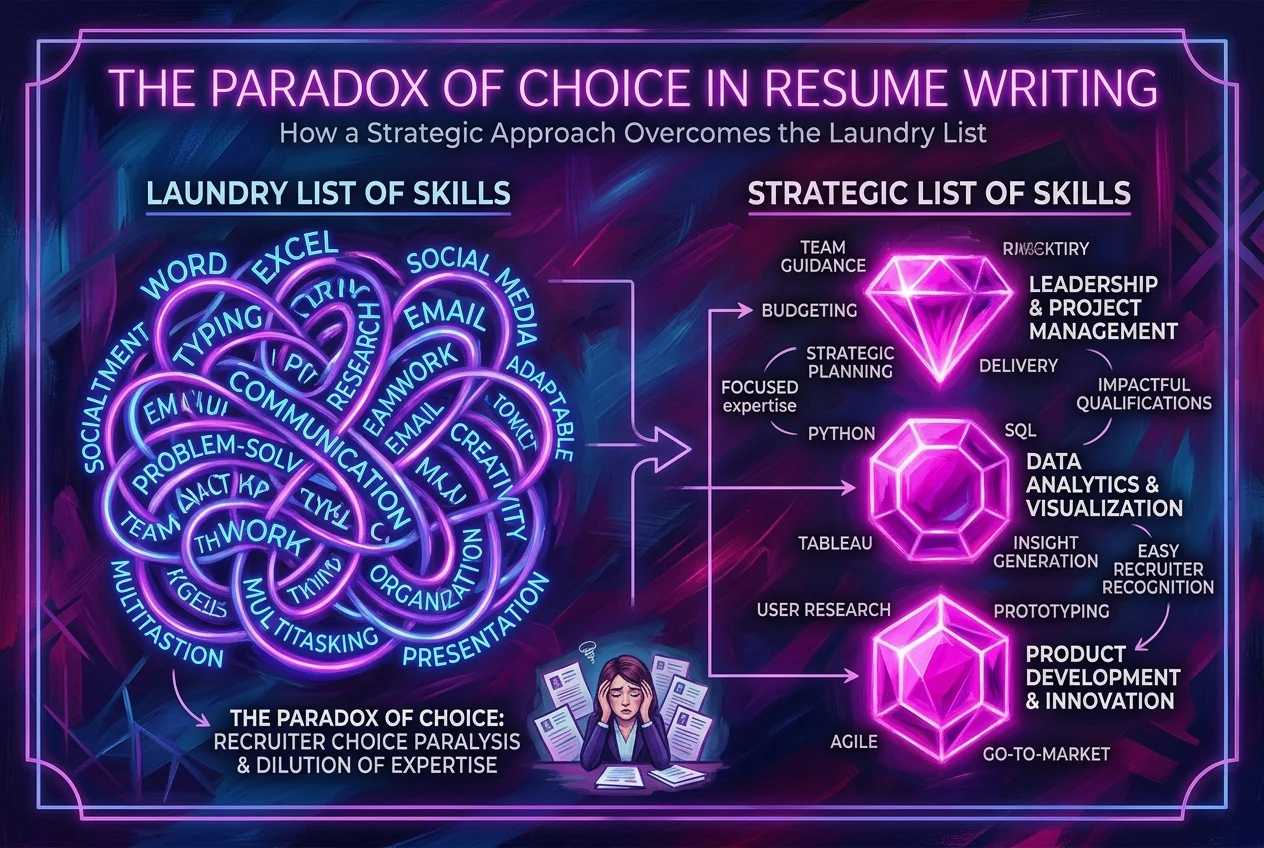
The most common mistake in resume writing is the "kitchen sink" approach. Many job seekers believe that by listing every skill they have ever touched—from 10th-grade Spanish to a software program they used once in 2014—they increase their chances of hitting a keyword match. It is essential to learn what not to include in a resume skills section to ensure your most valuable talents aren't buried under noise.
The Dilution of Expertise
When you list 20 to 30 different job skills, you dilute your actual expertise. A recruiter looking at a massive list can’t discern what you are truly great at versus what you are merely familiar with.
The Psychology of Choice: In psychology, the "Paradox of Choice" suggests that having too many options leads to decision paralysis. For a recruiter, seeing a cluttered skills section creates mental fatigue. They stop looking for what they need and start looking for a reason to move to the next candidate.
The "Baseline" Skill Problem
Are you still listing "Email," "Internet Research," or "Microsoft Word" on your resume? Unless you are applying for a very specific entry-level administrative role or learning how to write a resume with no experience, these are considered "baseline" skills. In 2024, listing them is like a professional driver listing "Starting a car" as a skill. It doesn't make you look proficient; it makes you look like you’re struggling to find relevant things to say.
| Instead of These "Empty" Skills... | Use These "High-Impact" Skills... |
|---|---|
| Communication | Stakeholder Management, Conflict Resolution |
| Microsoft Excel | Data Modeling, Pivot Tables, VLOOKUP/XLOOKUP |
| Problem Solving | Root Cause Analysis, Strategic Planning |
| Social Media | Social Analytics, Content Strategy, Paid Ad Campaigns |
| Teamwork | Cross-functional Collaboration, Agile Methodology |
2. The Myth of the ATS Keyword Dump
Many candidates have been told that the Applicant Tracking System (ATS) is a "dumb" robot that simply counts how many times a keyword appears. This has led to the disastrous trend of "keyword stuffing"—the practice of cramming as many resume skills as possible into a hidden or visible list.
How Modern ATS Actually Works
Modern ATS platforms (like Workday, Taleo, or Greenhouse) are much smarter than they used to be. They don't just look for the word "Python"; they look for "Python" in relation to your work history.
If you list "Python" in a skills block but never mention it in your professional experience section, the ATS may assign you a lower "relevancy score." Why? Because the system is programmed to prioritize experience over claims. To avoid this, you must learn how to tailor your resume for every job application specifically. Utilizing an AI-driven platform like CareerBoom.ai can streamline this alignment process, ensuring your skills are presented in a way that both robots and humans appreciate.
Contextual Relevance
The ATS also looks for "keyword proximity." If the job description asks for "Project Management in a SaaS environment," and your resume has "Project Management" in the skills list but "SaaS" is only mentioned in a job from five years ago, the system might not rank you as a top match.
The Fix: Your skills section should be a summary of the skills that are proven in your professional experience section. They must mirror each other.
3. The "Show, Don't Tell" Deficit
The biggest reason a skills section hurts you is the lack of evidence. Anyone can write "Expert in Digital Marketing." Very few people can write "Increased organic traffic by 40% through SEO and Content Strategy."
The Proof Gap
When a recruiter sees a skill, they immediately ask: “How well do they know this?” and “What have they done with it?”
If your skills are isolated in a bulleted list, you aren't answering those questions. You are leaving it up to the recruiter's imagination, and in resume writing, you never want to leave things to chance.
Turning Skills into "Achievement Clusters"
Instead of a static list, consider grouping your skills into categories that suggest action.
- Bad: JavaScript, React, Node.js
- Better: Full-Stack Development: Developed and deployed 5+ scalable web applications using JavaScript, React, and Node.js, reducing server latency by 15%.
By adding a tiny bit of context, you’ve moved from a "claim" to a "fact."
4. The Soft Skill Paradox
"Soft skills" (interpersonal skills) are arguably more important than hard skills in the long run. However, the skills section is the worst place to put them.
Why Soft Skills on a List Fail
Soft skills are subjective. If you tell me you are "Creative," I have no reason to believe you. Creativity is demonstrated through your portfolio, your descriptions of how you solved problems, and the way you present your resume. If you need inspiration, review our list of 150+ words to describe yourself to find more impactful ways to frame your personality.
The "Evidence-Based" Soft Skill
If you want to highlight "Leadership," don't put it in a list. Instead, put it in your professional experience:
"Led a team of 12 developers to complete a 6-month project 2 weeks ahead of schedule."
This proves leadership, which is a critical trait for leadership roles that need human influence in an increasingly automated world. Listing it as a bullet point under "Skills" is just white noise.
5. Visual Mistakes: Skill Bars and Graphs
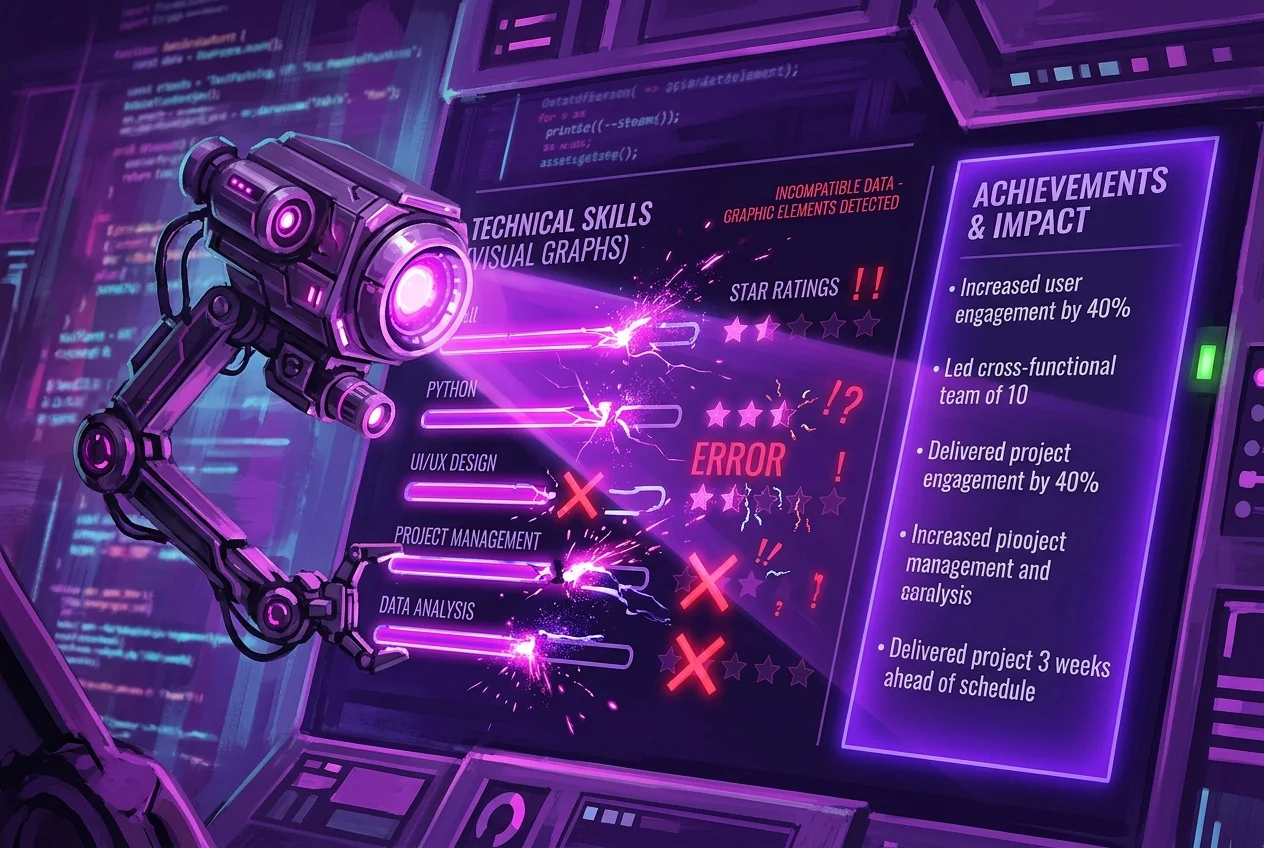
A growing trend in "creative" resume writing is the use of proficiency bars or star ratings (e.g., Photoshop: 4/5 stars). This is one of the most damaging things you can do to your resume.
The Subjectivity Trap
Who is the judge of your 4/5 stars? Is your 4-star "Photoshop" skill the same as a professional graphic designer’s 4-star skill? Of course not. It’s a purely subjective metric that provides zero actual information to the recruiter.
The "Self-Sabotage" Factor
If you give yourself 3 out of 5 stars in "Project Management," you are literally telling the recruiter, "I am not great at this." Why would you highlight a deficiency?
ATS Incompatibility
Most ATS software cannot read charts, graphs, or images. If you use a visual bar to represent your skills, the ATS might see a blank space or a garbled mess of characters, effectively deleting your skills from your digital profile.
6. How to Build a High-Impact Skills Section
Now that we know what's wrong, let’s look at how to fix it. A high-impact skills section is strategic, organized, and validated.
Step 1: The Skill Audit
Before you write a single word, look at the job description. Identify the "Hard Skills" (tools, languages, certifications) and the "Domain Knowledge" (industry-specific expertise like "Revenue Recognition" or "Supply Chain Logistics").
Step 2: Categorization
Break your skills into logical groups. This makes the section skimmable and professional.
Example for a Marketing Professional:
- Technical Tools: Google Analytics 4, HubSpot, SEMRush, Salesforce.
- Digital Strategy: SEO/SEM, PPC Campaign Management, Email Marketing Automation.
- Content & Creative: Copywriting, Adobe Creative Suite, Video Production.
Step 3: Use the "Core Competencies" Model
For senior roles, replace the "Skills" section with a "Core Competencies" section near the top of the resume. This should be a mix of your most valuable job skills and the specific areas where you provide the most ROI (Return on Investment).
7. The Power of "T-Shaped" Skills
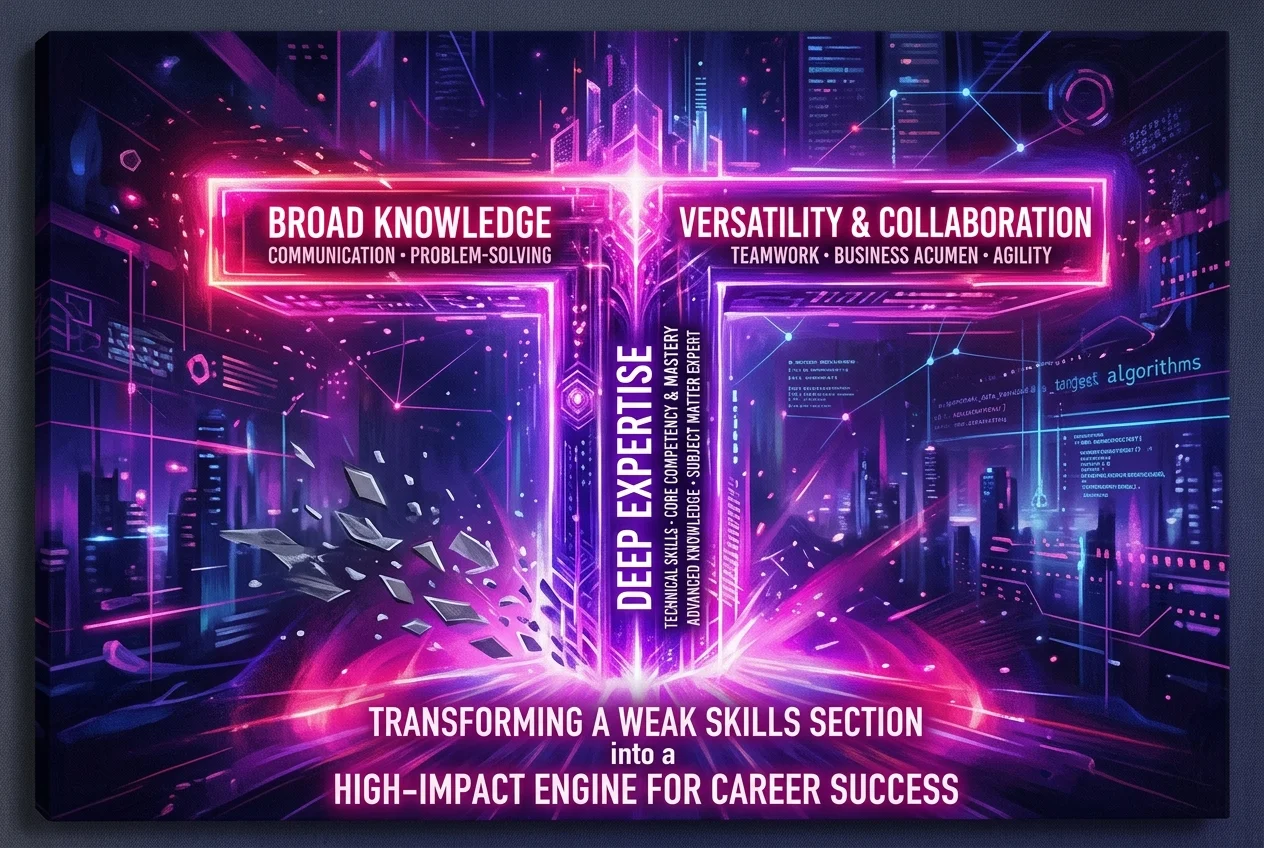
In modern recruitment, managers are looking for "T-Shaped" employees.
- The Horizontal Bar: Broad knowledge of many related areas.
- The Vertical Bar: Deep, specialized expertise in one or two areas.
Your resume skills section should reflect this. If you are a Software Engineer, your "Vertical Bar" might be "Backend Architecture with Java." Your "Horizontal Bar" might include "Cloud Computing," "Agile Mentorship," and "UI/UX Principles." Showing that you have both depth and breadth makes you a much more attractive candidate, especially when highlighting essential skills for the AI era.
8. Industry-Specific Skill Strategies
Different industries have different expectations for resume writing. Tailoring your skills section to your field is essential, particularly if you are trying to showcase skills for a remote job resume.
Tech and Engineering
- Focus: Languages, frameworks, and libraries.
- Strategy: Group by "Proficient" vs. "Familiar." This shows honesty and helps recruiters place you in the right role.
- Key Tip: Include your GitHub or Portfolio link right next to the skills section.
Creative and Design
- Focus: Software mastery and specific design methodologies.
- Strategy: Don't just list "Adobe Suite." Specify "InDesign for Print Layout" or "After Effects for Motion Graphics."
- Key Tip: Your skills section should be clean and minimalist to reflect your design sensibility.
Management and Leadership
- Focus: Methodologies (Six Sigma, Agile, PMP) and business outcomes.
- Strategy: Use "Soft Skills" that are tied to business metrics, like "Change Management" or "P&L Responsibility."
- Key Tip: Focus on "Transferable Skills" that show you can lead in any environment.
9. Leveraging "Transferable Skills" During Career Changes
If you are considering a career change at 30, 40, or 50, your skills section is your most important asset. However, this is where most people fail by listing skills relevant to their old job.
The Translation Layer
You must "translate" your job skills into the language of your new industry.
- Old Role (Teacher): Lesson Planning, Classroom Management.
- New Role (Corporate Trainer): Curriculum Development, Group Facilitation, Stakeholder Engagement.
By changing the terminology, you show the recruiter that you already have the necessary resume skills for the new role, following a practical blueprint for a fearless career change.
10. The 3-Point Check for Every Skill
Before you include a skill on your resume, put it through this 3-point test. If it doesn't pass all three, leave it off.
- Is it relevant? Does the job description ask for this, or is it a "nice-to-have" for this specific role?
- Can I prove it? If an interviewer asks, "Tell me about a time you used [Skill]," do I have a story ready?
- Is it current? Have I used this skill in the last 3-5 years? (Technology moves fast; a 2015 certification in a defunct software is a liability).
11. Strategic Placement: Where Does the Section Go?
Where you place your skills section depends on your experience level and the resume format you choose.
The Top-Third Rule
If your skills are your strongest selling point (e.g., you are a highly technical specialist), place a "Technical Skills" or "Core Competencies" section in the top third of your resume, just below your professional summary. This ensures the recruiter sees your value immediately.
The Bottom-Page Strategy
If you have 10+ years of experience, your work history is your strongest selling point. In this case, keep a concise "Skills" or "Tools & Technologies" section at the very end. It serves as a final "keyword check" for the ATS and the recruiter after they’ve read about your achievements.
The Sidebar (Use with Caution)
Sidebars are popular in modern templates. They are great for saving space, but they can be tricky for ATS. If you use a sidebar, ensure the text is selectable (not an image) and that the reading order is logical.
12. Transforming "Boring" Skills into "High-Impact" Achievements
Let’s look at a practical transformation. This is how you take a resume from "ignored" to "interviewed."
The "Before" Skills Section (Boring & Low-Impact):
- Skills: Customer Service, Sales, Microsoft Office, Communication, Time Management.
The "After" Skills Section (High-Impact & Strategic):
- Sales & Relationship Management: Managed a portfolio of 50+ high-net-worth clients, maintaining a 95% retention rate.
- Technical Proficiency: Advanced Salesforce CRM (Reporting & Dashboards), Microsoft Excel (Data Analysis), Slack.
- Operational Excellence: Streamlined client onboarding process, reducing "time-to-first-value" by 20%.
Why the "After" works:
- It uses categories.
- It integrates tools with actions.
- It uses numbers (95%, 50+, 20%).
- It removes generic fluff like "Communication."
13. The Role of Certifications and Continuous Learning
In a world where skills become obsolete every few years, your skills section should also demonstrate your commitment to growth.
Validating Your Skills
If you claim to be an expert in "Cloud Security," having an AWS Certified Security – Specialty badge next to that skill adds instant 100% credibility.
Showing "Learning Agility"
Listing a few recent certifications or courses (from platforms like Coursera, LinkedIn Learning, or industry-specific bodies) tells a recruiter: "I am not just someone who has skills; I am someone who acquires skills." This "learning agility" is often more valuable than any single technical skill.
14. Common Resume Writing Mistakes to Avoid
To ensure your skills section is working for you, avoid these common resume writing mistakes that often prevent qualified candidates from being noticed:
- Lying or Exaggerating: This seems obvious, but many people "stretch" their proficiency. Check out the things you should never lie about on your resume to protect your career integrity.
- Using Internal Jargon: Don't use skill names that only exist within your current company (e.g., "Level 4 Global Process Specialist"). Use industry-standard terms.
- Ignoring the "Human" Reader: While ATS is important, a human eventually has to read this. Avoid long, comma-separated blocks of text that are hard on the eyes.
- Being Too Vague: "Software" is not a skill. "Adobe Creative Suite" is a skill. "Adobe Premiere Pro" is an even better skill. Learning to identify common resume mistakes and how to fix them will help you refine your application for maximum impact.
15. Conclusion: Quality Over Quantity
The era of the "keyword dump" is over. To succeed in today’s job market, your resume skills section must be a curated, evidenced, and strategically placed showcase of your professional value.
Stop thinking of your skills section as a list of things you can do. Start thinking of it as a list of problems you can solve. When you shift your perspective from "What skills do I have?" to "What skills does this employer need to see proof of?", your resume writing will become significantly more effective—especially when supported by a complete job search platform like CareerBoom.ai that handles everything from smart job matching to interview preparation.
By auditing your current list, removing the fluff, adding context, and aligning your skills with your actual achievements, you turn a boring section into a high-impact narrative. Don't let a poorly constructed skills list be the reason your resume ends up in the "no" pile. Give your skills the context they deserve, and let your value speak for itself.
Final Action Plan for Your Resume
- Delete the "Soft Skills" list. Integrate those qualities into your bullet points.
- Remove "Baseline" skills. (Word, Email, etc.)
- Categorize your hard skills. Use 3-4 clear headings.
- Add 1-2 metrics. Try to tie at least two of your core skills to a specific number or result.
- Match the Job Description. Ensure the top 5 skills mentioned in the job ad are clearly visible in your section.
- Check for ATS Readability. Ensure your skills are in a standard text format, and know how to explain employment gaps if they appear in your history.
By following these steps, you ensure that your job skills are not just seen, but believed—giving you the competitive edge you need to land your next big role.
Frequently Asked Questions
Quick answers to common questions
1
Should I list soft skills in my resume skills section?
No, listing soft skills like "communication" as a bullet point is often seen as meaningless fluff. Instead, you should demonstrate soft skills through achievements in your professional experience section. For example, instead of writing "leadership," describe a time you led a team of 10 to exceed a quarterly sales goal by 15%.
2
How many skills should I include on my resume?
Focus on quality over quantity. Aim for 10–15 highly relevant skills categorized into logical groups. Avoid the "laundry list" trap, as listing too many skills dilutes your actual expertise and can lead to recruiter fatigue or decision paralysis.
3
Are skill bars or proficiency graphs effective on a resume?
No, you should avoid visual skill bars. They are subjective (a 4/5 rating has no standard meaning) and often unreadable by ATS software. Using them can result in your skills being ignored by digital screening tools or make you look like you are highlighting your own deficiencies.
4
How do I optimize my skills section for an ATS?
Modern ATS platforms look for contextual relevance. To optimize your section:
- Mirror keywords found in the specific job description.
- Ensure skills in your list also appear within your work history.
- Use standard text formats rather than images, charts, or complex sidebars.
5
What are baseline skills and should I list them?
Baseline skills are basic proficiencies like Microsoft Word, Email, or Internet Research. In the modern job market, these are considered "given" abilities. Listing them can make you appear outdated or underqualified. Only include them if the job is strictly entry-level or specifically requests them.
6
What is a T-shaped skills profile?
A T-shaped profile demonstrates both breadth and depth. The horizontal bar represents your broad knowledge across various related fields, while the vertical bar highlights your deep, specialized expertise in one or two core areas. Showing this balance makes you a much more attractive candidate to hiring managers.
7
Where is the best place to put the skills section on a resume?
Placement depends on your career stage:
- Technical Specialists: Use a "Core Competencies" section in the top third of the page.
- Experienced Professionals: Place a concise list at the bottom to serve as a final keyword check for the ATS after your achievements have been read.
8
How can I turn a boring skill into a high-impact achievement?
Use Achievement Clusters to provide context. Instead of just listing "Salesforce," write: "CRM Management: Optimized Salesforce workflows for a team of 20, resulting in a 12% increase in lead conversion rates." This moves the skill from a simple claim to a proven fact.
Was this article helpful?
Table of Contents
1. The "Laundry List" Trap: Why More Isn't Better
2. The Myth of the ATS Keyword Dump
3. The "Show, Don't Tell" Deficit
4. The Soft Skill Paradox
5. Visual Mistakes: Skill Bars and Graphs
6. How to Build a High-Impact Skills Section
7. The Power of "T-Shaped" Skills
8. Industry-Specific Skill Strategies
9. Leveraging "Transferable Skills" During Career Changes
10. The 3-Point Check for Every Skill
11. Strategic Placement: Where Does the Section Go?
12. Transforming "Boring" Skills into "High-Impact" Achievements
13. The Role of Certifications and Continuous Learning
14. Common Resume Writing Mistakes to Avoid
15. Conclusion: Quality Over Quantity
1Should I list soft skills in my resume skills section?
2How many skills should I include on my resume?
3Are skill bars or proficiency graphs effective on a resume?
4How do I optimize my skills section for an ATS?
5What are baseline skills and should I list them?
6What is a T-shaped skills profile?
7Where is the best place to put the skills section on a resume?
8How can I turn a boring skill into a high-impact achievement?
Share this article
Other articles
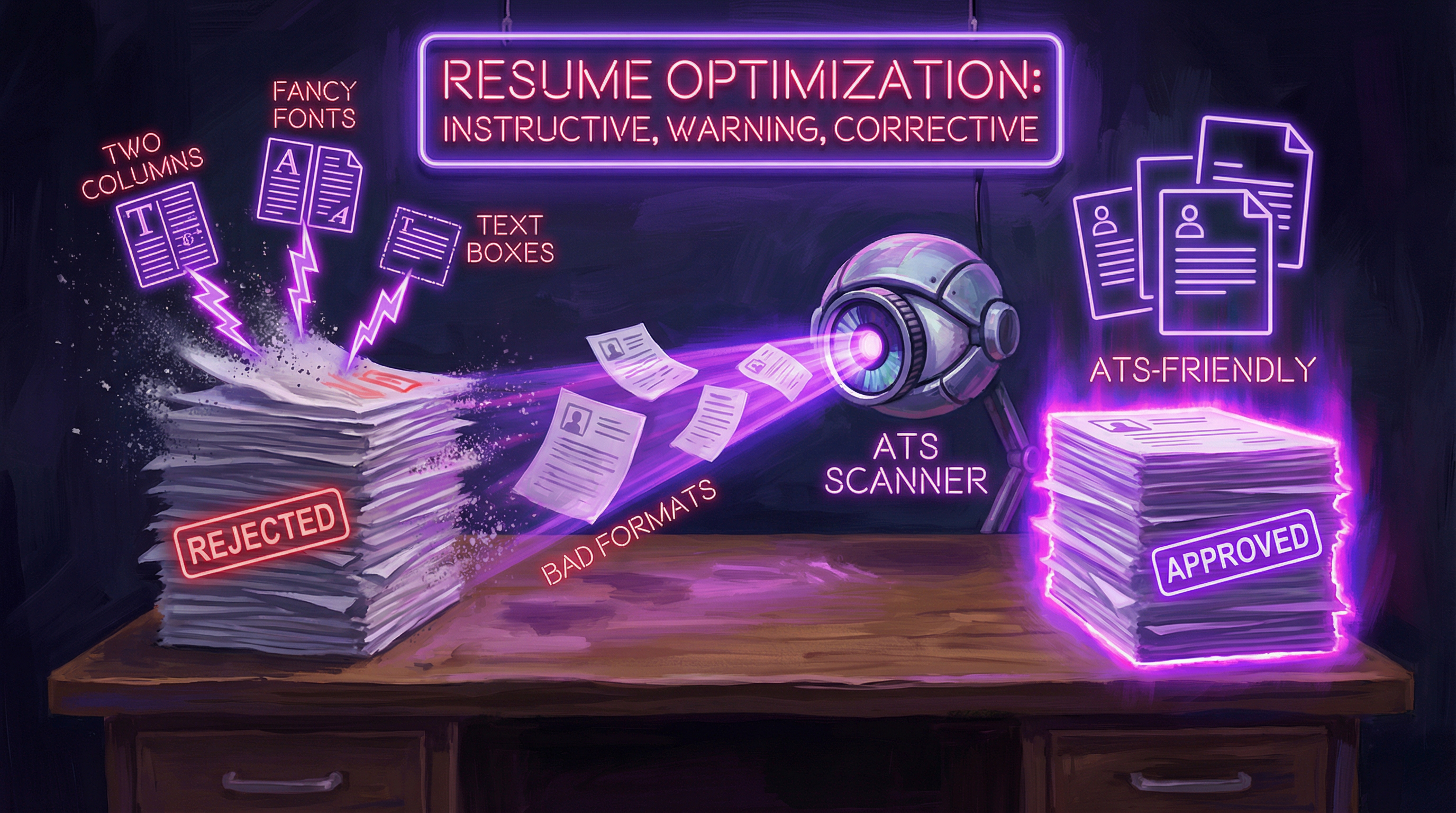
Bad Resume Examples: What NOT to Do in 2026 (And How to Fix It)
Avoid the resume mistakes that get you auto-rejected. See real examples of bad formats versus modern, ATS-friendly layouts.

Tailor Your Resume for Every Job: 7 Proven Strategies to Beat ATS
Master the art of customizing your resume for each job application, increasing your chances of passing applicant tracking systems (ATS) and getting noticed.

The ONLY Resume Format That Gets You Interviews, Guaranteed
Stop guessing! Learn the scientifically proven resume format that consistently lands interviews and impresses hiring managers.