Tailor Your Resume for Every Job: 7 Proven Strategies to Beat ATS
Master the art of customizing your resume for each job application, increasing your chances of passing applicant tracking systems (ATS) and getting noticed.
2 months ago - Updated 6 days ago

The Era of Precision: Why a Generic Resume is Your Biggest Obstacle

In today's fiercely competitive job market, the days of sending out a single, generic resume and hoping for the best are long gone. In fact, experts reveal that customizing your resume for every job application is what really works in today's landscape. The digital age has revolutionized the way companies recruit, introducing a formidable gatekeeper: the Applicant Tracking System (ATS). These sophisticated software programs are the first hurdle almost every job application must clear, sifting through hundreds, sometimes thousands, of resumes to identify candidates who best match the job requirements. If your resume isn't specifically designed to speak the ATS's language, it risks being overlooked, regardless of your qualifications.
The true secret to landing more interviews isn't just about having impressive experience; it's about strategically presenting that experience to both machines and humans. This applies whether you have years of experience or are learning how to write a resume with no experience. This means mastering the art of resume customization – a critical skill that can dramatically increase your chances of success. This article will delve into seven proven strategies that will empower you to tailor resume for every single job application, ensuring it's not only an ats friendly resume but also a compelling document that captures the attention of human recruiters. By understanding these techniques, you'll move beyond generic submissions and start crafting targeted applications that truly resonate.
Understanding the Modern Job Search Landscape: The ATS Gauntlet
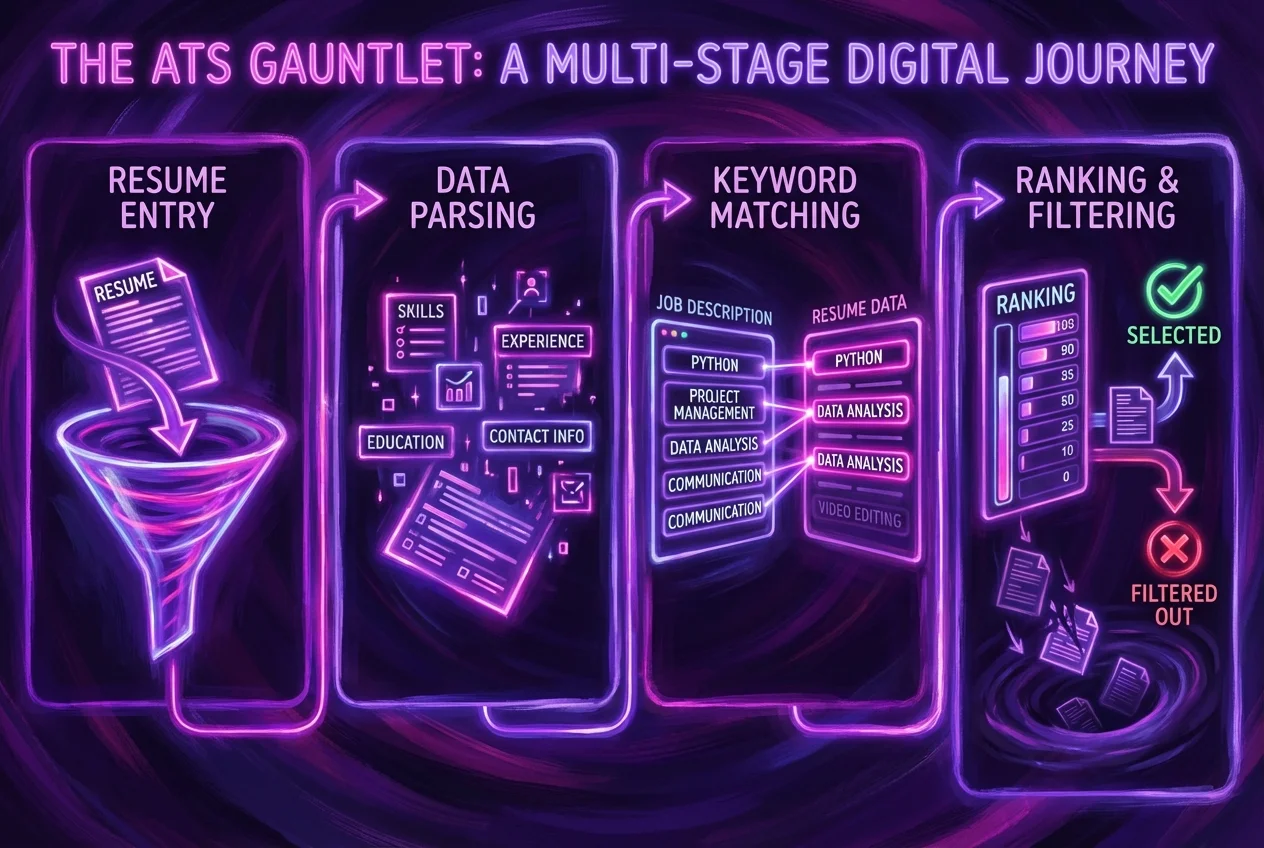
Before we dive into the strategies, it's crucial to grasp the landscape of modern recruitment. When you submit a job application online, it typically doesn't go straight to a human recruiter. Instead, it's often fed into an Applicant Tracking System. Think of ATS as a digital filter designed to streamline the hiring process for companies. Its primary function is to scan, parse, and rank resumes based on keywords, skills, and experience directly relevant to the job description.
How ATS Works:
- Parsing: The ATS extracts information from your resume (contact details, work history, education, skills) and organizes it into a searchable database.
- Keyword Matching: It compares the keywords in your resume against the keywords identified in the job description. The more matches, the higher your score.
- Ranking: Based on keyword relevance, formatting, and other criteria, the ATS assigns a score or rank to each applicant. Only the top-scoring resumes are typically forwarded to human recruiters.
Why Resume Customization is Non-Negotiable:
A generic resume, while perhaps well-written, often fails to include the specific keywords and phrasing that an ATS is programmed to look for in a particular job description. This means even highly qualified candidates can be rejected by the system simply because their resume wasn't optimized. Resume customization isn't about fabricating experience; it's about strategically highlighting the most relevant aspects of your background and aligning them perfectly with what the employer is seeking. It’s about translating your skills and achievements into the specific language of the job. For a more in-depth guide on how to tailor your resume for every job application, additional resources are available.
By embracing these tailor resume strategies, you're not just playing the system; you're demonstrating your attention to detail, your understanding of the role, and your genuine interest in the position – qualities highly valued by both machines and hiring managers.
Tailor Your Resume for Every Job: 7 Proven Strategies to Beat ATS
Now, let's explore the actionable strategies that will transform your generic resume into a powerful, targeted tool designed to clear the ATS hurdle and impress human recruiters.
Strategy 1: Deconstruct the Job Description – Your Blueprint for Success

The job description is not just a list of responsibilities; it's a treasure map, detailing exactly what the employer is looking for. Before you even think about opening your resume, dedicate significant time to dissecting every word of the job posting. This is the foundational step for effective resume customization.
How to Deconstruct:
- Identify Core Keywords: Read through the job description multiple times, highlighting or noting down all the key skills, qualifications, responsibilities, and technologies mentioned. Pay close attention to nouns and action verbs.
- Example: If the description says "Proficiency in project management software such as Jira and Asana," these are critical keywords. If it mentions "managing cross-functional teams" or "developing strategic marketing plans," these phrases are also crucial.
- Categorize Keywords: Group the identified keywords into categories:
- Hard Skills/Technical Skills: (e.g., Python, SQL, Salesforce, SEO, financial modeling)
- Soft Skills/Transferable Skills: (e.g., Communication, Leadership, Problem-Solving, Teamwork, Adaptability)
- Action Verbs: (e.g., Developed, Managed, Implemented, Analyzed, Optimized)
- Industry-Specific Terminology: (e.g., Agile methodologies, GAAP, HIPAA compliance)
- Experience Requirements: (e.g., "5+ years experience," "proven track record")
- Frequency Analysis: Note how often certain keywords or phrases appear. The more frequently a term is used, the more important it is to the employer, and the more vital it is to include in your resume.
- Understand the "Why": Beyond just listing keywords, try to understand the underlying needs and challenges the employer is trying to solve by hiring for this role. This deeper understanding will help you frame your experiences in a more impactful way.
- Create a Keyword List: Compile a master list of these keywords. This list will be your guide as you
tailor resumecontent.
Tool Tip: Copy and paste the job description into a word cloud generator (like WordArt.com or TagCrowd.com). The larger words in the cloud are often the most frequently used and therefore most important keywords. This visual representation can be incredibly helpful.
Strategy 2: Keyword Optimization – Beyond Simple Copy-Pasting
Once you have your comprehensive keyword list from deconstructing the job description, the next step is to strategically integrate these keywords into your resume. This is where many applicants make a critical mistake: simply stuffing keywords without context. ATS can often detect keyword stuffing, and it certainly won't impress a human recruiter. The goal is natural, meaningful integration.
Effective Keyword Integration Techniques:
- Resume Summary/Objective: Start strong by incorporating 3-5 key skills and experiences relevant to the job in your professional summary or objective statement. This is often the first section an ATS scans.
- Example: Instead of "Highly motivated professional seeking new opportunities," try: "Results-oriented Digital Marketing Manager with 7 years of experience in SEO, SEM, and content strategy, skilled in driving traffic and lead generation through data-driven campaigns." (If these are keywords from the JD).
- Skills Section: Create a dedicated "Skills" section (or "Core Competencies") and list both hard and soft skills directly from the job description. Use the exact phrasing where appropriate (e.g., "Project Management Software" vs. "PM Tools").
- Consider creating sub-sections: Technical Skills, Software, Languages, Methodologies, etc., to organize them clearly.
- Experience Section Bullet Points: This is arguably the most crucial area for keyword integration. For each relevant past role, revise your bullet points to naturally incorporate the job description's keywords.
- Before (Generic): "Managed marketing campaigns."
- After (Optimized): "Spearheaded multi-channel digital marketing campaigns, resulting in a 25% increase in qualified leads and 15% growth in website traffic." (Assuming "multi-channel digital marketing campaigns," "qualified leads," and "website traffic" were keywords).
- Before (Generic): "Used various software tools."
- After (Optimized): "Utilized Jira and Asana for project tracking and team collaboration across 5 cross-functional teams."
- Education Section (If Applicable): If the job description emphasizes specific coursework, certifications, or projects, and they align with your education, include them here.
- Use Synonyms Wisely: While exact matches are best for ATS, using relevant synonyms can also be beneficial, especially for human readers. However, prioritize the exact keywords from the job description first.
- Review for Readability: After integrating keywords, read your resume aloud. Does it flow naturally? Does it still make sense? If it sounds forced or repetitive, adjust it. Remember, an
ats friendly resumemust also be recruiter-friendly.
Strategy 3: Quantify Your Achievements – Show, Don't Just Tell
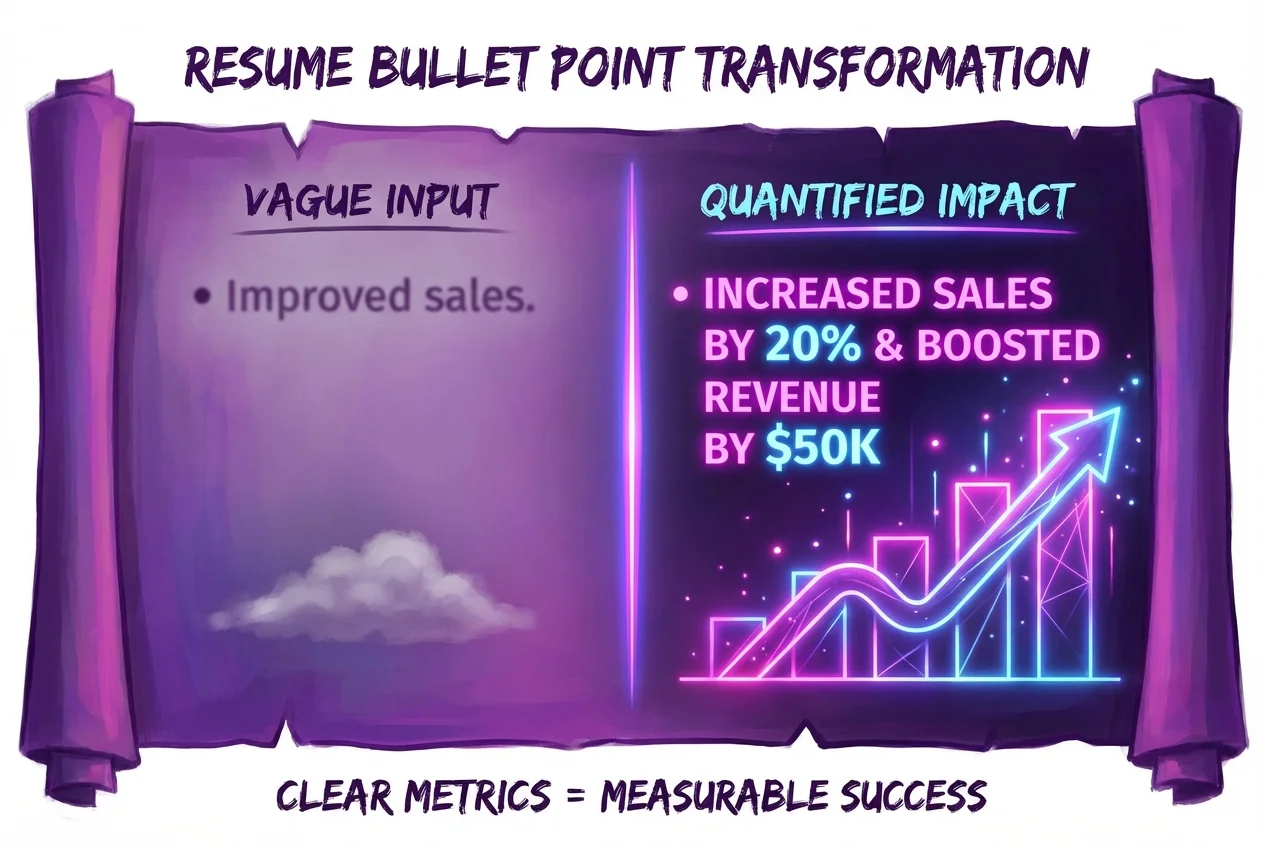
While keywords help you get past the ATS, quantifying your achievements is what truly makes your resume stand out to human recruiters. Numbers, percentages, and metrics provide concrete evidence of your impact and demonstrate the value you brought to previous roles. This strategy elevates your resume customization from merely matching words to showcasing tangible results.
Why Quantification Matters:
- Impact: It clearly illustrates the scope and success of your work.
- Credibility: Specific numbers are more believable than vague statements.
- ATS Recognition: Many ATS systems are evolving to recognize numerical data as indicators of strong performance.
- Recruiter Engagement: Recruiters are drawn to metrics because they directly relate to business outcomes.
How to Quantify Effectively:
- Identify Key Performance Indicators (KPIs): Think about the main metrics relevant to your past roles.
- Sales: Revenue generated, pipeline growth, client acquisition.
- Marketing: Website traffic, lead generation, conversion rates, social media engagement, ROI.
- Project Management: On-time delivery rates, budget adherence, project scope, team size managed.
- Customer Service: Resolution rates, customer satisfaction scores, call volume.
- Operations: Efficiency improvements, cost reductions, process optimization.
- Use the "STAR" Method (Situation, Task, Action, Result) in Brief: While STAR is for interviews, the "Result" part is crucial for your resume. Focus on the outcome of your actions.
- Weak: "Managed social media accounts."
- Strong: "Grew social media engagement by 30% across three platforms (Facebook, Instagram, LinkedIn) over six months, resulting in a 15% increase in brand awareness."
- Be Specific with Numbers: Don't just say "increased sales"; say "increased sales by 20%."
- Weak: "Improved customer satisfaction."
- Strong: "Achieved a 95% customer satisfaction rating by implementing a new feedback system and training program for a team of 10 representatives."
- Provide Context: Explain what the numbers mean. Was a 20% increase good for your industry or company?
- Use Strong Action Verbs: Pair your numbers with powerful verbs that convey accomplishment. (e.g., spearheaded, optimized, developed, launched, negotiated, streamlined).
- Don't Overdo It: While quantification is vital, every single bullet point doesn't need a number. Focus on your most impactful achievements. If you don't have exact numbers, use approximate figures (e.g., "increased efficiency by approximately 15%").
Table: Before & After Quantification Examples
| Before (Vague) | After (Quantified) |
|---|---|
| Managed a team. | Led and mentored a team of 5 software engineers, improving project delivery efficiency by 15%. |
| Handled customer inquiries. | Resolved an average of 50+ customer inquiries daily, maintaining a 98% customer satisfaction score. |
| Developed marketing materials. | Created 10+ marketing campaigns annually, which contributed to a 20% increase in lead generation over two years. |
| Improved website performance. | Optimized website content and structure, resulting in a 35% improvement in organic search rankings and a 10% reduction in bounce rate. |
| Responsible for budgeting. | Managed an annual departmental budget of $500,000, achieving 5% cost savings through vendor negotiation and process optimization. |
Strategy 4: Choose the Right Resume Format and Design – ATS-Friendly First

An ats friendly resume isn't just about content; it's also about structure and design. While you might be tempted by visually appealing, graphic-heavy templates, many of these can be problematic for Applicant Tracking Systems. The goal is clarity, simplicity, and consistency.
Key Principles for ATS-Friendly Formatting:
- Standard Reverse-Chronological Format: This is the most preferred format for both ATS and recruiters. It lists your work experience from most recent to oldest.
- Avoid: Highly creative or functional resumes unless you are in a very specific creative field and are certain the company doesn't use ATS or explicitly asks for a portfolio-style resume.
- Clean, Simple Layout:
- Use Standard Headings: "Experience," "Education," "Skills," "Summary" are easily recognized by ATS. Avoid custom or unconventional section titles.
- Consistent Font: Stick to professional, widely available fonts like Arial, Calibri, Helvetica, Times New Roman, or Georgia. Use a size between 10-12pt for body text and 14-16pt for headings.
- Ample White Space: Don't cram too much information onto a page. White space improves readability for human eyes.
- Consistent Formatting: Use bolding, italics, and bullet points consistently.
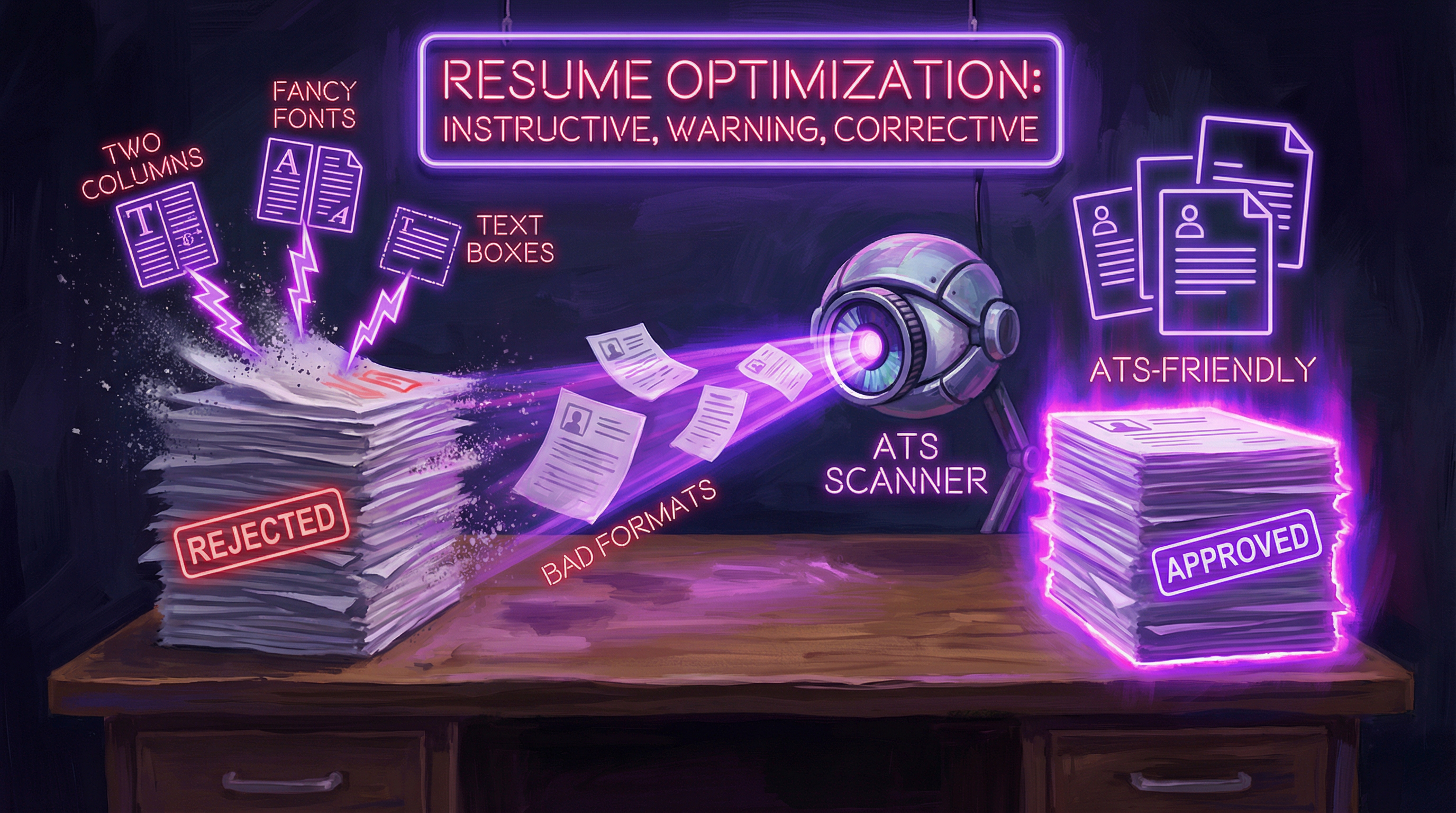
- No Graphics, Images, or Text Boxes: ATS often struggles to parse text embedded in images, text boxes, or complex tables. Avoid these elements entirely. Your headshot, company logos, or intricate design elements might look good to you, but they can render your resume unreadable to the system.
- Standard File Type: Always save and submit your resume as a
.docx(Microsoft Word document) or a plain text file (.txt) unless thejob applicationexplicitly requests a PDF. While many modern ATS can read PDFs, a.docxfile generally offers the highest compatibility and ensures the ATS can correctly parse your information without losing formatting. If a PDF is requested, ensure it's a searchable PDF (text-based, not an image-based scan). - Clear Section Separation: Use clear, bolded headings for each section. Avoid fancy dividers or graphics.
- Contact Information: Place your contact information (Name, Phone Number, Email, LinkedIn URL) at the very top of the resume in a clear, easily parsed format. Do not put it in a header or footer that might be missed by the ATS.
Table: ATS-Friendly vs. ATS-Unfriendly Design Elements
| ATS-Friendly Elements | ATS-Unfriendly Elements |
|---|---|
| Standard headings (e.g., Experience, Skills, Education) | Custom, artistic headings or icons |
| Common fonts (Arial, Calibri, Times New Roman) | Obscure or highly decorative fonts |
| Bullet points for achievements | Paragraphs of text, complex tables, or charts |
| Plain text for contact info at the top | Contact info embedded in a header/footer or graphic |
| .docx or searchable .pdf file format | .jpeg, .png, image-based .pdf, or other non-standard formats |
| Minimalist design, ample white space | Graphic-heavy templates, columns that merge text, text boxes, images, or logos |
By prioritizing an ATS-friendly format, you ensure that your carefully tailor resume content is actually read and understood by the initial screening software.
Strategy 5: Craft Compelling Bullet Points – The Power of Action and Result
Your resume is not a job description; it's a marketing document for yourself. Each bullet point under your experience section should be a mini-story of achievement, not just a list of duties. This is where you combine strong action verbs, relevant keywords, and quantified results to create impactful statements. This strategy is central to effective resume customization.
The CAR (Challenge, Action, Result) or PAR (Problem, Action, Result) Method for Bullet Points:
While you won't write out full paragraphs for each bullet, think about the essence of these methods:
- Action Verb: Start each bullet point with a powerful, descriptive action verb.
- Specific Task/Project: Briefly describe what you did.
- Result/Impact: Clearly state the positive outcome or achievement, ideally with quantification.
Examples of Compelling Bullet Points:
-
Weak: "Responsible for managing social media."
-
Strong: "Developed and executed a comprehensive social media strategy across Instagram, Facebook, and LinkedIn, increasing engagement by 40% and growing follower count by 25,000 in one year." (Keywords: social media strategy, Instagram, Facebook, LinkedIn, engagement, follower count)
-
Weak: "Helped customers with their issues."
-
Strong: "Resolved complex technical issues for 20+ clients daily, consistently exceeding performance targets by 10% and contributing to a 95% customer retention rate." (Keywords: technical issues, clients, performance targets, customer retention)
-
Weak: "Assisted with project tasks."
-
Strong: "Collaborated with cross-functional teams to streamline project workflows, leading to a 15% reduction in project delays and successfully delivering 5 key projects ahead of schedule." (Keywords: cross-functional teams, project workflows, project delays, key projects)
Tips for Crafting Bullet Points:
- Start with strong action verbs: Refer to a list of strong action verbs (e.g., spearheaded, optimized, initiated, developed, collaborated, analyzed, negotiated, implemented). Avoid passive language.
- Focus on Achievements, Not Just Duties: Shift your mindset from "what I did" to "what I achieved."
- Integrate Keywords Naturally: Weave in the keywords identified from the job description seamlessly.
- Quantify Whenever Possible: As discussed in Strategy 3, numbers make your statements more impactful.
- Tailor to Each Role: Review and revise your bullet points for every
job applicationto ensure they directly address the requirements of that specific position. If a role emphasizes "client management," highlight bullet points demonstrating that skill. If it emphasizes "data analysis," bring those to the forefront. - Be Concise: Aim for one to two lines per bullet point. Recruiters scan, they don't read lengthy paragraphs.
- Vary Your Verbs: Don't start every bullet point with "Managed." Use a diverse range of verbs to keep your resume engaging.
Strategy 6: Proofread Meticulously and Get a Second Opinion – The Detail-Oriented Advantage
Even the most perfectly tailored and keyword-rich resume can be derailed by simple errors. Typos, grammatical mistakes, and inconsistent formatting signal a lack of attention to detail – a red flag for both ATS (which can misinterpret misspelled words) and human recruiters. This strategy, though seemingly basic, is paramount for an ats friendly resume that leaves a professional impression.
Why Meticulous Proofreading is Critical:
- Professionalism: Errors undermine your credibility and suggest carelessness.
- Clarity: Mistakes can obscure your message and make your achievements harder to understand.
- ATS Interpretation: A misspelled keyword might not be recognized by the ATS, causing your resume to be filtered out.
- Recruiter Perception: Recruiters often view errors as a reason to dismiss an otherwise qualified candidate.
Steps for Effective Proofreading:
- Read Aloud: Reading your resume aloud helps you catch awkward phrasing, grammatical errors, and missing words that your eyes might skim over silently.
- Print It Out: Reviewing a physical copy can reveal errors you missed on screen. The change in medium often provides a fresh perspective.
- Check for Consistency:
- Formatting: Are all headings the same size and style? Are all bullet points indented consistently? Is spacing uniform?
- Punctuation: Are you consistent with periods at the end of bullet points (either all or none)?
- Verb Tense: Ensure past tense for past roles and present tense for your current role (if applicable).
- Capitalization: Are job titles, company names, and proper nouns capitalized consistently?
- Spell Check and Grammar Check: Use your word processor's built-in tools, but don't rely on them exclusively. They won't catch every error (e.g., "there" instead of "their").
- Review Against Job Description (Again!): After all your edits, do one final check to ensure all critical keywords from the job description are still present and correctly spelled.
- Get a Second (or Third) Opinion: This is perhaps the most crucial step. Ask a trusted friend, mentor, career counselor, or family member to review your resume. A fresh pair of eyes can spot errors you've become blind to after multiple revisions. They can also offer feedback on clarity and impact.
- Specifically ask them: "Does this clearly articulate my value for the [Job Title] role at [Company Name]?" and "Are there any typos or grammatical errors?"
Common Mistakes to Look For:
- Typos: Especially in company names, job titles, and technical terms.
- Grammatical Errors: Subject-verb agreement, pronoun usage, sentence fragments.
- Punctuation Errors: Missing commas, incorrect apostrophes.
- Inconsistent Formatting: Varying bullet styles, different font sizes within sections.
- Missing Contact Information: Ensure your phone number and email are correct.
- Generic Language: Ensure you've effectively applied
resume customizationand avoided vague statements.
By taking the time for meticulous proofreading and seeking external review, you present a polished, professional document that reinforces your attention to detail – a highly valued trait in any professional setting.
Strategy 7: Leverage an ATS Checker and Iterate – Test and Refine
After all your hard work in tailoring your resume, how do you know if it's truly ats friendly resume? This is where technology comes to your aid. Utilizing an ATS checker or resume scanner allows you to test your resume's effectiveness before submitting it, giving you valuable insights and the opportunity to refine it further. Many advanced platforms, such as CareerBoom.ai, offer AI-powered resume and cover letter alignment with job descriptions, helping you ensure your application is perfectly optimized before you even hit submit.
What is an ATS Checker?
An ATS checker (or resume scanner) is a tool that simulates how an actual Applicant Tracking System would parse and evaluate your resume. You upload your resume and paste the job description, and the tool provides a report on how well your resume aligns with the job requirements.
How to Use an ATS Checker Effectively:
- Choose a Reputable Tool: Several online tools offer this service, some free, some paid (e.g., Jobscan.co, Resume Worded, SkillSyncer). Look for ones that provide detailed feedback.
- Upload Your Tailored Resume: Make sure you're uploading the version of your resume that you've specifically customized for the target
job application. - Paste the Job Description: Copy the entire job description (without any extra formatting) into the tool.
- Analyze the Report: The checker will usually provide a match score and highlight areas for improvement, such as:
- Missing Keywords: Identifies important keywords from the job description that are absent from your resume.
- Keyword Stuffing: Warns if you've overused certain keywords in an unnatural way.
- Formatting Issues: Points out potential problems that might hinder ATS parsing.
- Hard Skills vs. Soft Skills: Often categorizes and scores your skills.
- Action Verb Usage: May suggest stronger verbs.
- Iterate and Refine: This is the most critical step. Don't just look at the score; act on the feedback.
- Add Missing Keywords: If the report indicates missing keywords, find natural places to integrate them into your resume summary, skills section, or experience bullet points.
- Rephrase for Clarity: If certain phrases are flagged as unclear, reword them.
- Adjust Formatting: If formatting issues are detected, go back to your
.docxfile and make the necessary adjustments to ensure it's clean and simple. - Repeat the Process: After making changes, run your resume through the ATS checker again. Continue this cycle of testing and refining until you achieve a high match score (aim for 80% or higher, if the tool provides a percentage) and feel confident that your resume is both ATS-friendly and human-readable.
Benefits of Using an ATS Checker:
- Increased Confidence: You'll know your resume has a strong chance of getting past the initial digital screening.
- Targeted Improvement: The feedback is specific, allowing you to make precise adjustments.
- Time-Saving: Catching issues before submission saves you the frustration of applications going into a black hole.
- Learning Opportunity: It helps you understand what employers are truly looking for and how to better
tailor resumecontent in the future.
While an ATS checker is a powerful tool, remember it's a guide, not a definitive judge. Always ensure that the changes you make for ATS optimization still result in a resume that makes sense and sounds authentic to a human reader. The ultimate goal is to impress both the machine and the hiring manager.
Beyond ATS: Impressing Human Recruiters
While these seven strategies are primarily focused on helping you bypass the Applicant Tracking System, it's crucial to remember that your resume's ultimate audience is a human being. The good news is that an ats friendly resume built on these principles is inherently more appealing to human recruiters as well.
Here’s how these strategies benefit human review:
- Clarity and Readability: A clean, well-formatted resume (Strategy 4) with compelling bullet points (Strategy 5) and ample white space is easy for a recruiter to scan and digest quickly.
- Relevance: By deconstructing the job description (Strategy 1) and integrating keywords (Strategy 2), you ensure that your most relevant experience and skills are immediately apparent. Recruiters spend mere seconds on a resume initially, and seeing direct matches to their needs is paramount.
- Impact and Value: Quantifying your achievements (Strategy 3) provides concrete evidence of your capabilities, demonstrating the value you can bring to their organization. This moves beyond mere statements of responsibility to showcasing tangible results.
- Professionalism: A meticulously proofread resume (Strategy 6) free of errors reflects professionalism, attention to detail, and a high standard of work – qualities highly sought after by any employer.
- Targeted Approach: The entire process of
resume customizationshows recruiters that you're genuinely interested in this specific role and have taken the time to understand their needs, rather than just mass-applying. This dedication alone can set you apart.
The synergy between ATS optimization and human appeal is powerful. By strategically tailor resume for each job application, you're not just playing a technical game; you're crafting a highly persuasive document that speaks directly to the needs of both your automated and human audience.
Common Mistakes to Avoid in Resume Customization
Even with the best intentions, job seekers can fall into traps when attempting to tailor resume for specific roles. Being aware of these common pitfalls can save you time and prevent your efforts from being counterproductive.
- Keyword Stuffing: While integrating keywords is vital, simply listing them or repeating them unnaturally throughout your resume is a red flag. ATS can sometimes detect this, and human recruiters will certainly be put off by the lack of coherence. Focus on natural integration within context.
- Using Irrelevant Experience: Don't try to force-fit unrelated experience to match a job description. While transferable skills are valuable, fabricating relevance or stretching the truth will be evident and can harm your credibility. Focus on genuinely relevant experiences and highlight transferable skills where appropriate.
- Ignoring the Job Description's Tone: Pay attention to the language used in the job description. Is it formal or more casual? Technical or business-oriented? Try to mirror that tone in your resume where appropriate, especially in your summary.
- Neglecting Formatting for ATS: Overly creative or graphic-heavy designs, as discussed, can render your resume unreadable to ATS. Always prioritize a clean, simple, and standard format for initial submission, especially when applying online.
- Forgetting to Update Dates and Contact Info: A
tailor resumeis useless if it has outdated contact information or inaccurate dates for your employment history. Always double-check these details, and if you have them, learn how to explain employment gaps in resumes effectively. - One-Size-Fits-All Approach: The biggest mistake of all is failing to customize. Sending the same resume to every
job applicationis a guaranteed way to be overlooked by both ATS and recruiters in a competitive market. - Over-Optimization for ATS, Under-Optimization for Humans: Sometimes, in an effort to beat the ATS, candidates create resumes that are technically perfect but bland and uninspiring to read. Remember, a human will eventually read it. Ensure your personality, achievements, and unique selling points still shine through.
- Using Acronyms Without Explanation: If you use an industry-specific acronym, and it's not universally recognized, consider spelling it out the first time (e.g., "Customer Relationship Management (CRM)"). This helps both ATS (if the full phrase is a keyword) and human readers.
- Not Quantifying Achievements: As highlighted in Strategy 3, a lack of numbers and metrics makes it difficult for recruiters to grasp your impact and value. Always strive to quantify where possible.
- Lying or Exaggerating: Never falsify information or grossly exaggerate your responsibilities or achievements. Recruiters have ways of verifying information, and getting caught in a lie can permanently damage your professional reputation.
By consciously avoiding these common pitfalls, your resume customization efforts will be far more effective, leading to a stronger ats friendly resume and a better chance of landing an interview.
Tools and Resources for Resume Customization
The task of resume customization for every job application might seem daunting, but thankfully, there are numerous tools and resources available to streamline the process and enhance your efforts. Leveraging these can significantly reduce your workload and improve your resume's effectiveness.
1. Word Processors (Microsoft Word, Google Docs, Pages):
- Purpose: These are your primary tools for creating and editing your resume.
- Tips: Utilize their built-in spell check and grammar tools, and learn to use styles and formatting options to maintain consistency (Strategy 4). Always save in
.docxformat for maximum ATS compatibility.
2. Online ATS Scanners/Resume Checkers:
- Purpose: To test how well your resume matches a job description and identify areas for improvement (Strategy 7).
- Examples:
- Jobscan.co: One of the most popular and comprehensive tools, offering a match rate score, keyword comparison, and formatting feedback. Offers a limited number of free scans.
- Resume Worded: Provides instant feedback on resume and LinkedIn profiles, focusing on impact, skills, and ATS compatibility.
- SkillSyncer: Another tool that helps compare your resume against job descriptions to identify missing keywords.
- Vmock (often provided by universities): An AI-powered resume feedback platform, common in academic career centers. For a more comprehensive AI-powered platform that includes resume and cover letter builders aligned with job descriptions, smart job matching, and application tracking to simplify your entire job search, consider CareerBoom.ai.
3. Word Cloud Generators:
- Purpose: To visually identify the most frequently used keywords in a job description (Strategy 1).
- Examples: WordArt.com, TagCrowd.com, WordClouds.com.
- Tips: Copy and paste the entire job description to get an accurate representation of key terms.
4. Action Verb Lists:
- Purpose: To help you start your bullet points with powerful, impactful verbs (Strategy 5).
- Examples: Many career websites (e.g., The Muse, Indeed, LinkedIn) offer extensive lists of strong action verbs categorized by skill type. A quick Google search for "resume action verbs" will yield many results.
5. LinkedIn Learning / Online Courses:
- Purpose: To deepen your understanding of resume writing best practices, ATS optimization, and career development.
- Examples: Search for courses on "ATS resume," "resume writing," or "job search strategies."
6. Career Counselors and Coaches:
- Purpose: For personalized feedback, strategic advice, and a critical second opinion (Strategy 6).
- Tips: Many universities offer alumni career services. Professional career coaches can provide in-depth reviews and guidance tailored to your specific career goals.
7. Online Resume Builders (Use with Caution):
- Purpose: Can be helpful for quickly generating a basic resume, but often lack the flexibility for deep customization.
- Caution: Many free builders generate templates that are not ATS-friendly, especially those with complex designs or embedded graphics. If you use one, ensure it allows for a simple, clean, and
.docxexport.
By strategically incorporating these tools and resources into your job application process, you can significantly enhance your resume customization efforts, creating a truly ats friendly resume that stands out in a crowded market. Remember, the goal is to work smarter, not just harder, in your job search.
Conclusion: Empower Your Job Search with Strategic Resume Customization
The modern job search is a dynamic landscape, and mastering the art of resume customization is no longer an option – it's a necessity. By embracing the seven proven strategies outlined in this article, you equip yourself with the power to navigate the complexities of Applicant Tracking Systems and capture the attention of human recruiters.
Let's recap the transformative journey:
- Deconstruct the Job Description: Treat it as your blueprint, meticulously identifying every crucial keyword and requirement.
- Keyword Optimization: Seamlessly integrate those keywords into your summary, skills, and experience sections, speaking the ATS's language without sacrificing readability.
- Quantify Your Achievements: Transform vague duties into impactful accomplishments with concrete numbers and metrics, showcasing your tangible value.
- Choose the Right Resume Format and Design: Prioritize a clean, simple, and standard layout that ensures your resume is easily parsed by ATS.
- Craft Compelling Bullet Points: Use strong action verbs and the CAR/PAR method to create powerful, results-oriented statements.
- Proofread Meticulously and Get a Second Opinion: Eliminate errors and inconsistencies that could undermine your professionalism and credibility.
- Leverage an ATS Checker and Iterate: Test your resume's effectiveness against the job description and refine it until it achieves a high match score and human appeal.
By consistently applying these strategies for every job application, you move beyond the frustration of generic submissions and enter a realm of precision and purpose. You're not just sending out a document; you're sending a highly targeted marketing piece that demonstrates your qualifications, your attention to detail, and your genuine interest in the role.
The investment of time and effort into tailoring your resume for each job application is an investment in your career. It significantly increases your chances of passing the initial digital gatekeepers, getting noticed by hiring managers, and ultimately landing the interviews that lead to your next great opportunity. Stop hoping your resume gets seen; start ensuring it does. Your next dream job is within reach – take control of your job application process with strategic resume customization today.
Frequently Asked Questions
Quick answers to common questions
1
Why is it crucial to tailor my resume for each job application?
Tailoring your resume is crucial because most online applications first encounter an Applicant Tracking System (ATS). A generic resume often lacks the specific keywords and phrasing the ATS is programmed to find, leading to rejection regardless of qualifications. Customization ensures your resume speaks the ATS's language and resonates with human recruiters.
2
What is an Applicant Tracking System (ATS) and how does it work?
An ATS is software that scans, parses, and ranks resumes based on keywords, skills, and experience relevant to the job description. It extracts information, matches keywords from the job posting, and assigns a score. Only top-scoring resumes are typically forwarded to human recruiters.
3
How can I identify the most important keywords from a job description?
To identify keywords, deconstruct the job description:
- Read it multiple times, highlighting key skills, qualifications, and responsibilities.
- Categorize keywords (hard skills, soft skills, action verbs).
- Note frequency: terms used often are most important.
- Tip: Use a word cloud generator for visual analysis.
4
What's the best way to integrate keywords into my resume without keyword stuffing?
Integrate keywords naturally and meaningfully:
- In your summary/objective (3-5 key terms).
- In a dedicated Skills section (exact phrasing).
- Within experience bullet points, revise them to incorporate relevant keywords and quantify achievements.
- Ensure readability; avoid forced repetition.
5
Why is it important to quantify my achievements on my resume?
Quantifying achievements with numbers, percentages, and metrics provides concrete evidence of your impact. It demonstrates the value you brought to previous roles, making your resume more credible and compelling to human recruiters. Many ATS also recognize numerical data as indicators of strong performance.
6
What is the most ATS-friendly resume format and design?
The most ATS-friendly format is the standard reverse-chronological.
- Use a clean, simple layout with standard headings (e.g., "Experience," "Skills").
- Stick to professional fonts (Arial, Calibri).
- Avoid graphics, images, or text boxes.
- Submit as a .docx or searchable .pdf unless specified otherwise.
7
How can I make my resume bullet points more impactful?
Craft compelling bullet points using the Action-Result method:
- Start with a strong action verb.
- Describe the specific task or project.
- Clearly state the positive outcome or achievement, ideally with quantification.
- Integrate relevant keywords naturally.
Was this article helpful?
Table of Contents
The Era of Precision: Why a Generic Resume is Your Biggest Obstacle
Tailor Your Resume for Every Job: 7 Proven Strategies to Beat ATS
Beyond ATS: Impressing Human Recruiters
Common Mistakes to Avoid in Resume Customization
Tools and Resources for Resume Customization
Conclusion: Empower Your Job Search with Strategic Resume Customization
1Why is it crucial to tailor my resume for each job application?
2What is an Applicant Tracking System (ATS) and how does it work?
3How can I identify the most important keywords from a job description?
4What's the best way to integrate keywords into my resume without keyword stuffing?
5Why is it important to quantify my achievements on my resume?
6What is the most ATS-friendly resume format and design?
7How can I make my resume bullet points more impactful?
Share this article
Other articles

The ONLY Resume Format That Gets You Interviews, Guaranteed
Stop guessing! Learn the scientifically proven resume format that consistently lands interviews and impresses hiring managers.
Bad Resume Examples: What NOT to Do in 2026 (And How to Fix It)
Avoid the resume mistakes that get you auto-rejected. See real examples of bad formats versus modern, ATS-friendly layouts.

How to Write a Resume with No Experience (Student & Entry Level)
A complete guide for students and entry-level professionals to landing their first job.