The Forbidden Truth: 5 Things You Should NEVER Lie About on Your Resume (And 3 You Can Bend)
Navigating the ethical tightrope of resume writing: Discover what absolutely must be truthful and where you have a little room for strategic phrasing.
8 months ago - Updated 3 months ago
The job market is a fiercely competitive arena, where the pressure to stand out can feel immense. In the quest to secure that coveted interview, many job seekers find themselves contemplating a strategic "enhancement" or even an outright fabrication on their resume. It's a widespread phenomenon: a recent study revealed that a significant 70% of workers confess to having lied on their resumes at some point, with 37% admitting they lie frequently. Another survey suggests over half of job applicants have admitted to lying on their resumes. This staggering statistic highlights the pervasive temptation to embellish, but it also underscores a critical dilemma: where do you draw the line between strategic phrasing and career-ending dishonesty?
Navigating the ethical tightrope of resume writing requires a keen understanding of what absolutely must be truthful and where a little room for strategic phrasing might actually boost your chances without risking your professional reputation. This article will delve into the "forbidden truths" – five critical areas where lying on your resume is an absolute no-go – and explore three instances where a strategic "bend" can help you present your experience in the best possible light, all while upholding your career integrity. The goal is to equip you with the knowledge to craft a compelling, honest, and effective resume that opens doors, rather than slamming them shut.
The Forbidden Truth: 5 Things You Should NEVER Lie About on Your Resume
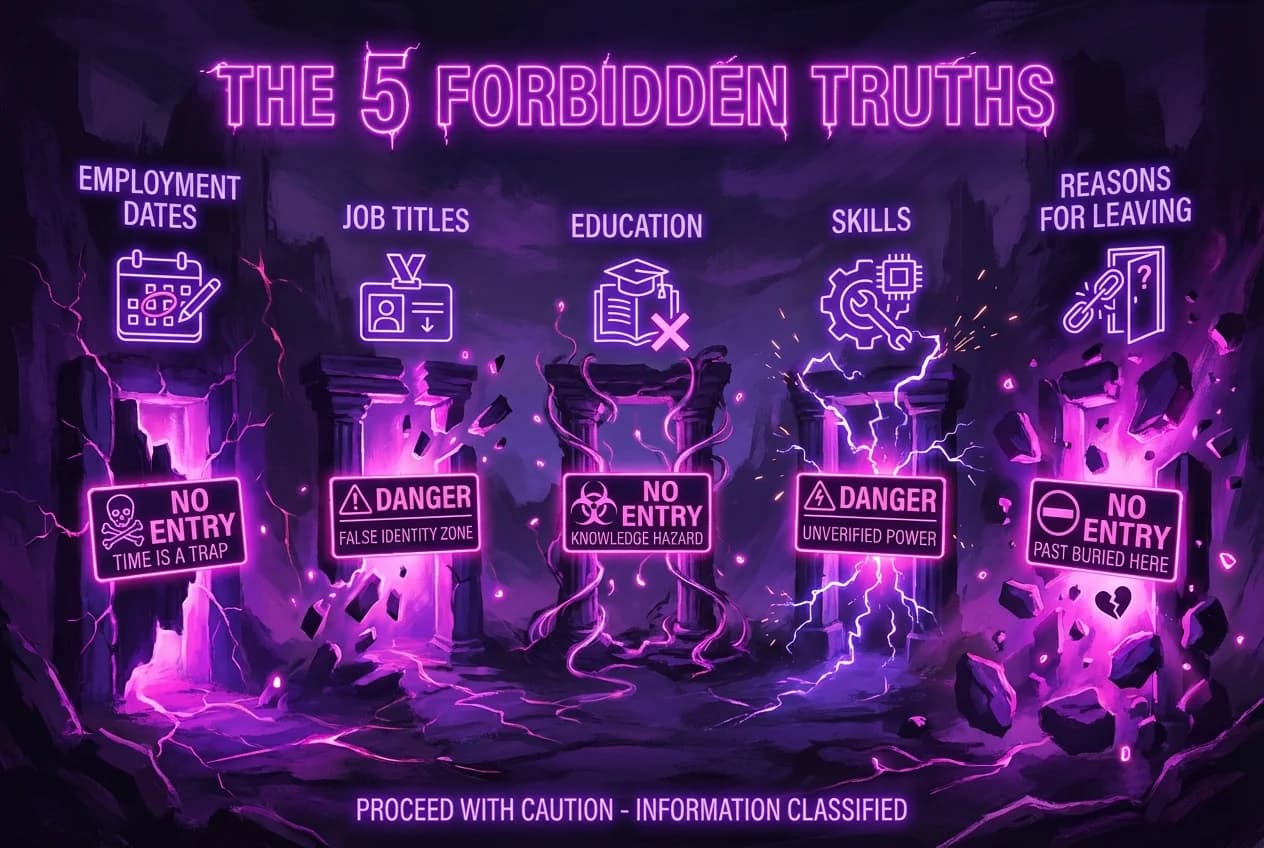
In the world of resume writing, some lines simply cannot be crossed. These are the non-negotiables, the facts that employers will almost certainly verify, and any dishonesty here carries severe and often irreversible consequences. Engaging in lying on your resume in these areas is a direct route to professional discredit and can severely damage your career integrity.
1. Employment Dates and History
Falsifying your employment dates or fabricating entire work experiences is one of the most common and easily detectable resume mistakes. Job seekers often do this to cover gaps in employment or to make it appear as though they held a position for a longer duration than they actually did. Studies show that about 37% of job seekers overstate their length of employment, and roughly a quarter fib about employment dates. Another survey indicated that 43% of respondents lied about how long they held a previous position.
Why it's a critical no-go: Employers are highly vigilant about employment history. They routinely conduct thorough background checks and directly contact previous employers to verify job titles, dates of employment, and even responsibilities. These checks are often outsourced to professional screening services that can confirm exact dates within 24-48 hours. Discrepancies in employment and academic verifications account for a significant 87% of all discrepancies detected via background checks.
Potential Consequences: If caught, the consequences can be immediate and severe. You could be disqualified from consideration, have a job offer rescinded, or even be terminated if the lie is discovered after you've been hired. Beyond the immediate job loss, such dishonesty can severely damage your professional reputation, making it harder to find future employment within the same industry or even in entirely different fields.
Example of a Lie:
- Lie: Stating you worked at Company A from January 2020 to December 2023 when you actually left in June 2022.
- Lie: Inventing a fictional company or role to fill a long employment gap.
2. Job Titles and Core Responsibilities
Inflating your job title or exaggerating your core responsibilities is another frequent resume mistake that crosses the line of resume honesty. For instance, someone might claim they were a "Project Manager" when their actual role was a "Project Coordinator," or they might list tasks they never performed. Embellishing job titles and responsibilities is a top lie, with 52% of job seekers admitting to it.
Why it's a critical no-go: Hiring managers and recruiters are skilled at discerning genuine experience from inflated claims. They will often verify job titles and responsibilities through reference checks, contacting former managers, or reaching out to the organization's human resources department. During interviews, you'll be expected to discuss your past roles in detail, and inconsistencies will quickly become apparent. Claiming full ownership of a project that was a team effort is also considered unethical.
Potential Consequences: If you lie about a job title or your responsibilities, you risk being hired for a role you are significantly underqualified for, leading to immense stress, poor performance, and eventual termination. More broadly, it undermines your credibility and can lead to a loss of trust from the employer, effectively ending your candidacy or employment.
Example of a Lie:
- Lie: Claiming to be a "Senior Vice President" when your actual title was "Director."
- Lie: Stating you "managed a team of 10 engineers" when you were an individual contributor.
3. Educational Background and Degrees

Falsifying academic credentials, such as claiming a degree you didn't earn, listing an institution you never attended, or exaggerating your GPA, is a grave resume mistake with serious repercussions. This is a common area of dishonesty, with 29.6% of individuals lying about their college degree, 11% about education credentials, and 44% about their educational background. Even executives are not immune, with 16% of executive resumes containing false academic claims.
Why it's a critical no-go: Educational background is one of the easiest details for employers to verify. They can do this by directly calling the school or using services like the National Student Clearinghouse. A significant 57% of American employers verify education details when hiring. Any discrepancies can be quickly uncovered during background checks.
Potential Consequences: Lying about your education can lead to immediate disqualification from the hiring process. If discovered after employment, it's grounds for termination. In certain professions, especially those requiring specific licenses or certifications (e.g., medical, legal), falsifying credentials can even lead to legal ramifications, including civil charges, allegations of fraud, substantial fines, or in extreme cases, imprisonment. This severely impacts your career integrity and can make future employment impossible.
Example of a Lie:
- Lie: Listing a Bachelor's degree from a university when you only completed two years of coursework.
- Lie: Claiming a Ph.D. from an accredited institution when you bought a fake certificate online.
4. Critical Skills and Certifications
Claiming proficiency in skills you don't possess or listing certifications you haven't earned is another perilous path. This includes everything from advanced software knowledge to fluency in foreign languages or specialized technical skills. Inflated skill sets top the list of false claims, with over 60% of candidates lying about their abilities. About 15% of job seekers lie in their skills section, and 40% admit to embellishing their skills.
Why it's a critical no-go: Employers often test for technical or role-specific abilities during interviews, practical assessments, or even during a probation period. If you claim "advanced Excel proficiency" but struggle with a basic spreadsheet during a skills test, your dishonesty will be glaringly obvious. Similarly, claiming fluency in a language will likely be tested during an interview.
Potential Consequences: The immediate consequence is often disqualification, as your inability to demonstrate the claimed skills makes you unsuitable for the role. It can also lead to a complete loss of trust and damage your professional reputation. Even if you manage to get hired, struggling to perform core job functions due to a lack of genuine skills will lead to negative evaluations and potential termination. This type of lying on resume directly impacts your ability to perform and sustain a role, undermining your career integrity.
Example of a Lie:
- Lie: Stating you are "fluent in Mandarin" when you only know a few basic phrases.
- Lie: Listing "Certified Project Management Professional (PMP)" when you've never taken the exam.
5. Reasons for Leaving Previous Jobs or Fabricated Jobs
Being dishonest about why you left a previous employer, or worse, fabricating an entire job to hide a termination or a difficult departure, is a significant ethical breach. While only 9% of Brits admit to lying about their reasons for leaving past roles, it's still a common area of concern. Fabricating an entire position is a lie for 24% of job seekers.
Why it's a critical no-go: Employers will often seek to understand the trajectory of your career, and the reasons for leaving previous roles are a key part of that narrative. Reference checks with former supervisors can easily reveal discrepancies in your stated reasons versus the actual circumstances. If you were terminated for cause, a background check or a candid conversation with a former manager could expose this lie.
Potential Consequences: Being caught in a lie about your departure can lead to immediate rejection, as it raises serious questions about your trustworthiness and resume ethics. It can also severely damage your professional reputation, particularly if the reason for your departure involved misconduct or poor performance. Maintaining resume honesty in this area, even if it means presenting a challenging truth carefully, is far better than being exposed for dishonesty.
Example of a Lie:
- Lie: Stating your previous role was "dissolved due to company restructuring" when you were actually fired for poor performance.
- Lie: Inventing a freelance consulting gig for a year to avoid mentioning being unemployed.
The Art of Strategic Phrasing: 3 Things You Can Bend on Your Resume
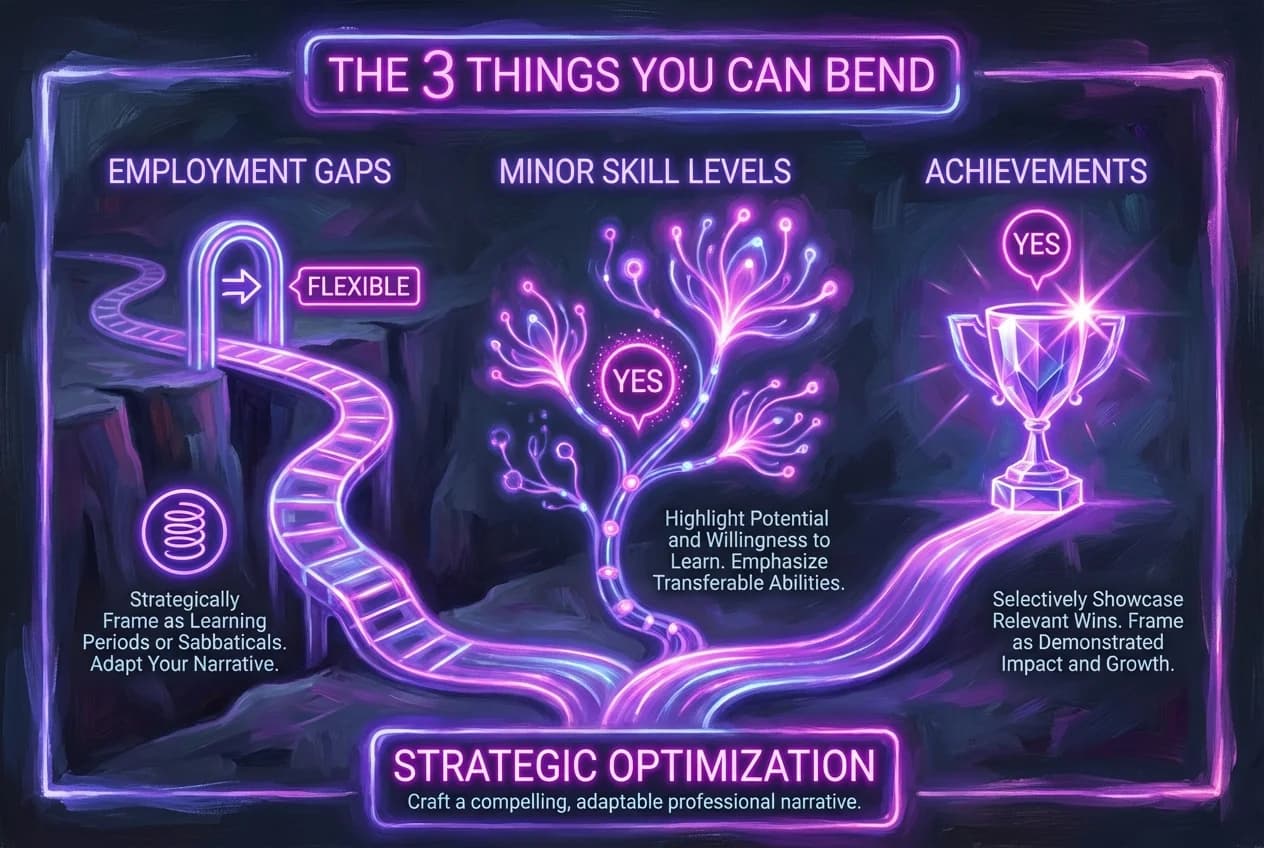
While outright lying on resume is a dangerous game, there are certain areas where strategic phrasing and careful presentation can help you showcase your best self without compromising resume honesty or career integrity. This isn't about deception; it's about optimization and focusing on what's most relevant and impactful.
1. Explaining Employment Gaps

Employment gaps are increasingly common and less stigmatized in today's dynamic job market. However, many job seekers still feel compelled to "fudge dates" to make gaps look shorter. Over a quarter of people (28%) suggest they would alter employment dates to hide a gap. Instead of lying, which can easily be caught during employment verification, the key is to address them transparently and positively.
How to "Bend" Strategically:
- Omit Months for Shorter Gaps: For employment gaps less than a year, you can often omit the months from your employment dates and simply list the years (e.g., "2020-2022" instead of "May 2020 - February 2022"). This can visually smooth over small breaks without being dishonest, provided you're prepared to give exact dates if asked.
- Redefine the Gap with Productive Activities: If you had a longer gap, focus on what you did during that time. Did you pursue professional development, volunteer, travel, care for family, or work on personal projects? These experiences can be framed as valuable skill-building opportunities.
- Example: Instead of leaving a blank, you could list:
- "Career Break: Family Caregiving & Professional Development | January 2023 - Present"
- Developed strong organizational and time management skills while managing household and family responsibilities.
- Completed [relevant online courses/certifications] to enhance [specific skills].
- Volunteered [organization name] assisting with [tasks] to maintain [relevant skills].
- "Career Break: Family Caregiving & Professional Development | January 2023 - Present"
- Example: Instead of leaving a blank, you could list:
- Use a Functional or Hybrid Resume Format: These formats de-emphasize chronological work history and highlight your skills and qualifications upfront. This allows you to lead with your strengths and transferable skills, making the employment dates less prominent.
- Address in the Cover Letter: Use your cover letter to briefly and honestly explain the reason for a significant gap, focusing on lessons learned or skills gained. Keep it concise and professional, then pivot to how you're ready to re-enter the workforce.
What NOT to do:
- Do not invent fake jobs or extend employment dates to cover a gap. Employers will verify.
2. Minor Skill Levels and Proficiency
Many job seekers feel pressure to list every skill as "expert" or "advanced." While you should never claim a skill you don't possess at all, you can strategically present your current proficiency level without undermining your resume honesty. The goal is to highlight your capabilities truthfully and demonstrate a willingness to learn and grow.
How to "Bend" Strategically:
- Focus on Application, Not Just Mastery: Instead of simply listing "Microsoft Excel: Advanced," describe how you've used Excel to achieve results.
- Example: Instead of: "Proficient in Python," try:
- "Python: Applied Python for data analysis and automation of routine reporting tasks, reducing manual effort by 15%."
- Example: Instead of: "Proficient in Python," try:
- Use Descriptive Language for Proficiency: Instead of arbitrary levels, use terms that reflect your practical experience.
- "Familiar with" or "Working knowledge of": For tools or software you've used but aren't deeply proficient in.
- "Experience with" or "Applied": For skills you've actively used in a professional context.
- "Proficient in" or "Advanced in": Reserve these for skills where you can confidently perform complex tasks and troubleshoot independently.
- Highlight Transferable Skills: If you're new to a specific technical skill, emphasize related transferable skills. For instance, if you're learning a new programming language, highlight your problem-solving abilities, logical thinking, or experience with other coding languages.
- Be Ready to Demonstrate: Only list skills you can confidently discuss and, if necessary, demonstrate in an interview or assessment. Don't add keywords you've just read online if you can't explain their meaning or application.
What NOT to do:
- Do not claim expertise in a skill you barely understand or have never used professionally. This will quickly be exposed during technical interviews or on-the-job tasks.
3. Non-Linear Career Paths and Job Titles
In today's dynamic professional landscape, non-linear career paths are increasingly common. People change industries, pivot roles, or return to the workforce after breaks. The challenge is to present this diverse experience cohesively, highlighting how your varied background makes you a unique and valuable candidate, rather than a scattered one. You can also strategically address job titles that might not fully reflect your responsibilities.
How to "Bend" Strategically:
- Reframe Experience with Transferable Skills: Instead of focusing solely on job titles, emphasize the transferable skills gained in each role that are relevant to your target position.
- Example: If transitioning from a "Retail Manager" to a "Project Coordinator":
- Focus on skills like "team leadership," "inventory management," "customer service excellence," and "problem-solving" as they translate to "project planning," "stakeholder communication," and "issue resolution."
- Example: If transitioning from a "Retail Manager" to a "Project Coordinator":
- Use a Combination or Hybrid Resume Format: Similar to employment gaps, these formats allow you to lead with a strong "Summary" or "Skills" section that connects your diverse experiences to the new role, followed by a streamlined chronological work history.
- Tailor Job Titles (with caution): If your official job title didn't accurately reflect your senior-level responsibilities, you can consider tweaking the title to be more descriptive or putting an alternative, more representative title in parentheses.
- Example: If your title was "Office Administrator" but you managed complex projects and supervised staff, you might write: "Office Administrator (Project & Operations Lead)."
- CRITICAL: Never inflate your title to a significantly higher level (e.g., "Director" to "SVP"). The "bend" here is about clarity and accuracy of responsibility, not outright promotion.
- Connect the Dots in Your Cover Letter: Use your cover letter to tell the story of your career journey, explaining how your non-traditional path has equipped you with unique strengths and perspectives relevant to the new role.
What NOT to do:
- Do not invent job titles or roles that bear no resemblance to your actual experience. This is a form of lying on resume and will be uncovered through verification.
- Do not misrepresent the industry or type of company you worked for.
The Grave Consequences of Lying on Your Resume
The temptation to embellish a resume might seem like a small risk for a potentially big reward, especially in a competitive job market. However, the reality is that lying on resume carries grave and far-reaching consequences that can derail your career and damage your career integrity irrevocably. To understand more about the significant risks of resume dishonesty, it's important to consider how employers are increasingly sophisticated in their verification methods, making it highly likely that dishonesty will be uncovered.
High Likelihood of Being Caught
Despite the prevalence of resume lies, employers are highly vigilant.
- 85% of hiring managers report catching a lie on a resume.
- A staggering 81.4% of resume liars eventually get caught at some point.
- Most lies are uncovered before the job even begins, often during the interview process (38.4%) or even earlier.
- Background checks are a standard part of the hiring process for 95% of employers. These checks often include employment verification, education verification, and criminal records. One in four background checks uncover discrepancies between what candidates claim and what's true.
Immediate Disqualification and Offer Withdrawal
The most immediate consequence of detected dishonesty is often the withdrawal of a job offer. A survey found that 35.5% of those caught lying had their offer withdrawn. Employers view dishonesty as a fundamental breach of trust and a red flag, leading to immediate disqualification from consideration. Your resume might even be flagged in their applicant tracking system (ATS) as a "do not hire," preventing future opportunities with that company.
Termination from Employment
Even if a lie isn't discovered during the hiring process, it can catch up to you months or even years into your employment. If an employer discovers you falsified information, you can be terminated immediately, regardless of your performance. Many employment contracts include clauses that allow for termination if material misrepresentations are found on your application.
Damage to Professional Reputation and Credibility
Being caught in a lie can severely tarnish your professional reputation and credibility, which are crucial for long-term career success. In a networked world, news of dishonesty can spread quickly within an industry, potentially hurting your future job prospects. Hiring managers have long memories, and a negative reputation can be difficult to overcome. This loss of trust impacts your career integrity profoundly.
Difficulty Finding Future Employment
Once your reputation is compromised, it can become significantly harder to find a job in the future. Employers are hesitant to hire individuals they perceive as untrustworthy. This can lead to a prolonged job search, limited opportunities, and potentially having to settle for roles below your actual capabilities.
Legal Ramifications
While lying on a resume isn't typically a criminal offense on its own, certain types of falsification can lead to legal trouble. For a deeper dive into the potential legal consequences of resume fraud, understanding these distinctions is crucial.
- Fraud: If you falsify information that can be legally verified, such as degrees, certifications, or professional licenses, it may cross the line into fraud. This is especially true for roles requiring specific professional qualifications where a lack of proper credentials could lead to harm or malpractice.
- Civil Charges: In some cases, if your lack of qualifications (due to a lie) results in financial harm to the company or its clients, you could face civil charges.
- Fines and Imprisonment: In extreme cases, particularly for highly regulated professions where public safety is at stake, falsifying credentials can result in huge fines and even imprisonment.
The ethical gamble of lying on resume simply isn't worth the potential rewards. The personal stress of maintaining a lie, the risk of being caught, and the severe professional and potential legal repercussions far outweigh any perceived short-term gain. Upholding resume ethics and career integrity is the only sustainable path to a successful and fulfilling career.
The Importance of Authenticity and Career Integrity
In a world that often prioritizes speed and superficial impressions, the enduring value of authenticity and career integrity cannot be overstated. Your resume is more than just a document; it's a reflection of your professional self, a testament to your skills, experiences, and most importantly, your character.
Building a career on a foundation of truth establishes a crucial element that employers value above almost all else: trust. When you present your qualifications and experiences truthfully, you immediately build a foundation of trust with a potential employer. This trust is not merely a nicety; it's a cornerstone of effective teamwork, positive work environments, and strong professional relationships. As Warren Buffet famously stated, "You're looking for three things, generally, in a person: intelligence, energy, and integrity. And if they don't have the last one, don't even bother with the first two". This quote succinctly captures the paramount importance of integrity in the professional sphere.
Authenticity on your resume ensures that you are matched with roles that genuinely fit your skills and aspirations. When you're honest about your capabilities, you're more likely to land a job where you can truly excel, grow, and feel satisfied, rather than constantly battling imposter syndrome or struggling to meet expectations based on false claims. This accurate self-assessment is vital for both personal and professional development.
Furthermore, maintaining career integrity safeguards your professional reputation – an asset that takes years to build and moments to destroy. In an interconnected professional landscape, where information travels fast, a reputation for honesty and ethical conduct is invaluable. It opens doors, fosters networking opportunities, and ensures that you are seen as a reliable and trustworthy professional throughout your career journey.
Ultimately, an honest resume is a powerful tool. It allows you to present your true self, highlight your genuine strengths, and articulate your unique value proposition without the constant fear of exposure. It demonstrates respect for yourself, for the hiring process, and for the potential employer. This commitment to resume honesty is not just the right thing to do; it is the smartest long-term strategy for a successful and fulfilling career.
Tips for Crafting an Honest Yet Compelling Resume
Creating a resume that is both truthful and stands out in a crowded applicant pool requires a strategic approach. Here are actionable tips to help you highlight your strengths while maintaining impeccable resume honesty and career integrity:
-
Tailor Your Resume to Each Job Application:
- Instead of using a generic resume, customize it for every position you apply for. Analyze the job description and highlight the skills, experiences, and accomplishments that are most relevant to that specific role. This shows employers you understand their needs and have genuinely considered the position. Tools like CareerBoom.ai can significantly streamline this process by providing AI-powered resume and cover letter builders that align your documents perfectly with job descriptions, ensuring you hit all the right keywords without resorting to dishonesty.
- Actionable Tip: Use keywords from the job description naturally throughout your resume, especially in your summary, skills section, and experience bullet points. This helps pass applicant tracking systems (ATS) and catches the eye of recruiters.
-
Focus on Quantifiable Achievements, Even if Approximate:
- Employers are impressed by results. Whenever possible, quantify your achievements with numbers, percentages, or metrics. Even if you don't have exact figures, you can use approximate terms (e.g., "increased efficiency by approximately X%") as long as you can confidently discuss the impact and how you arrived at that estimate during an interview.
- Actionable Tip: Instead of "Managed social media," try "Grew social media engagement by 20% over 6 months, contributing to a 10% increase in web traffic." If you don't have exact percentages, "Significantly increased social media engagement" is better than no impact statement at all, provided you can elaborate on how it was significant.
-
Use Strong Action Verbs:
- Begin your bullet points with powerful action verbs that convey impact and initiative (e.g., "Developed," "Implemented," "Led," "Optimized," "Streamlined"). This makes your accomplishments more dynamic and engaging.
- Actionable Tip: Review your bullet points and replace weak verbs or passive language with stronger, more active alternatives.
-
Proofread Meticulously for Accuracy and Professionalism:
- A resume riddled with typos or grammatical errors undermines your professionalism and attention to detail. Double-check all dates, job titles, educational credentials, and contact information for accuracy.
- Actionable Tip: Read your resume backward, ask a trusted friend or mentor to review it, and use online grammar checkers. Ensure consistency in formatting and phrasing.
-
Be Prepared to Discuss Everything on Your Resume:
- Every claim, skill, and experience listed on your resume should be something you can confidently elaborate on during an interview. If you list a skill, be ready to provide examples of how you've used it. If you mention a project, be prepared to discuss your specific contributions and the outcomes. Platforms like CareerBoom.ai offer interview preparation and simulation tools that can help you practice articulating your experiences clearly and confidently, reinforcing your resume's honesty.
- Actionable Tip: Practice explaining your resume bullet points out loud. Anticipate questions about any areas that might seem less clear or require further explanation.
-
Seek Permission for References:
- Always obtain permission from your references before listing them on your resume or providing their contact information. This is a matter of professional courtesy and ensures they are prepared to speak positively on your behalf.
- Actionable Tip: Inform your references about the roles you're applying for and what aspects of your experience you'd like them to highlight.
-
Leverage Your Cover Letter for Context:
- Use your cover letter as an opportunity to provide context for any aspects of your resume that might raise questions, such as employment gaps or a career change. This allows you to explain your situation proactively and positively, maintaining transparency without cluttering your resume.
- Actionable Tip: Keep explanations concise and focus on what you learned or accomplished during these periods, or how your diverse experience makes you a strong candidate.
By embracing these strategies, you can craft a resume that not only accurately reflects your professional journey but also powerfully showcases your potential, making you a standout candidate for the right reasons. This commitment to resume honesty will serve as a strong foundation for your entire job search and career trajectory.
Conclusion
Navigating the complexities of resume writing in a competitive job market can feel like a delicate balancing act. The temptation to embellish, or even outright lie, is a reality many job seekers face. However, as we've explored, the "forbidden truths" – your employment dates, job titles, educational background, critical skills, and reasons for leaving previous jobs – are non-negotiable areas where resume honesty is paramount. Fabricating information in these areas carries severe consequences, ranging from immediate disqualification and job offer withdrawal to termination, irreparable damage to your professional reputation, and even legal repercussions.
On the other hand, mastering the art of strategic phrasing allows you to present your unique journey in the best possible light without compromising your career integrity. Whether it's gracefully explaining employment gaps by highlighting productive activities, articulating your true skill levels through application-focused descriptions, or reframing a non-linear career path to emphasize transferable strengths, there are ethical ways to optimize your resume.
The core message is clear: career integrity is your most valuable professional asset. Employers universally value honesty and trustworthiness, recognizing them as foundational qualities for reliable and successful employees. By committing to resume ethics and crafting a document that is both truthful and compelling, you not only avoid the significant risks associated with lying on resume but also build a strong, authentic foundation for a fulfilling and respected career. Choose honesty; it's the only sustainable strategy for long-term success.
Frequently Asked Questions
Quick answers to common questions
You should never lie about these five critical areas on your resume, as they are easily verifiable and carry severe consequences:
- Employment Dates and History
- Job Titles and Core Responsibilities
- Educational Background and Degrees
- Critical Skills and Certifications
- Reasons for Leaving Previous Jobs
It's highly likely you'll be caught. Studies show 85% of hiring managers report catching a lie, and 81.4% of resume liars are eventually discovered. Most lies are uncovered during the interview process or through standard background checks, which 95% of employers conduct.
The consequences include immediate disqualification or job offer withdrawal. If discovered after hiring, it leads to termination from employment. It also severely damages your professional reputation and credibility, making it difficult to find future employment and impacting your overall career integrity.
Yes, strategic phrasing is acceptable in certain areas to present your experience optimally without compromising resume honesty. These include:
- Explaining Employment Gaps
- Minor Skill Levels and Proficiency
- Non-Linear Career Paths and Job Titles This is about optimization, not deception.
Instead of lying, you can:
- Omit months for shorter gaps (e.g., '2020-2022').
- Redefine the gap with productive activities like professional development, volunteering, or family caregiving.
- Use a functional or hybrid resume format.
- Address it briefly and positively in your cover letter.
Yes, employers routinely verify these details. They use background checks, directly contact previous employers to confirm job titles and dates, and verify education through institutions or services like the National Student Clearinghouse. Discrepancies are often quickly uncovered.
No, you should never claim expertise in a skill you don't possess. Instead, focus on how you've applied skills, use descriptive language like 'familiar with' or 'experience with,' and only list skills you can confidently discuss and demonstrate during an interview or assessment.
Was this article helpful?
Table of Contents
The Forbidden Truth: 5 Things You Should NEVER Lie About on Your Resume
The Art of Strategic Phrasing: 3 Things You Can Bend on Your Resume
The Grave Consequences of Lying on Your Resume
The Importance of Authenticity and Career Integrity
Tips for Crafting an Honest Yet Compelling Resume
Conclusion
1What are the most critical things you should NEVER lie about on your resume?
2How likely is it to get caught lying on a resume?
3What are the consequences of lying on your resume?
4Are there any areas where strategic phrasing or 'bending the truth' is acceptable on a resume?
5How can I explain employment gaps on my resume honestly?
6Can employers verify my educational background and job history?
7Is it okay to slightly exaggerate my skill level on a resume?
Share this article
Other articles

How to Explain Employment Gaps in Resumes: The 2026 Guide
Turn career breaks into strengths with our comprehensive guide for 2026
Bad Resume Examples: What NOT to Do in 2026 (And How to Fix It)
Avoid the resume mistakes that get you auto-rejected. See real examples of bad formats versus modern, ATS-friendly layouts.

The ONLY Resume Format That Gets You Interviews, Guaranteed
Stop guessing! Learn the scientifically proven resume format that consistently lands interviews and impresses hiring managers.