The Stealth Job Search: How to Find Roles Before They Are Posted
Master the hidden job market through strategic networking and proactive outreach.
12 days ago - Updated 7 days ago

The traditional job search is broken. You spend hours tailoring your resume, writing cover letters, and hitting "apply" on LinkedIn or Indeed, only to be met with the deafening silence of an automated applicant tracking system (ATS). Perhaps you receive a generic rejection email weeks later. This cycle is exhausting, demoralizing, and, most importantly, inefficient.
What if there was a better way? What if you could bypass the digital gatekeepers and walk through a door that most candidates don’t even know exists?
Welcome to the hidden job market. Industry experts estimate that between 70% and 85% of jobs are never publicly advertised. These roles are filled through internal promotions, referrals, and proactive outreach. This is the realm of the "stealth job search"—a strategic, high-impact approach to career advancement that focuses on building relationships before a vacancy even hits a job board.
In this comprehensive guide, we will dismantle the mystery of the hidden job market and provide you with a step-by-step blueprint for mastering the stealth job search.
Understanding the Hidden Job Market: Why It Exists
To navigate the hidden job market effectively, you must first understand why companies keep roles "stealth." It isn't a conspiracy to keep you unemployed; it’s a matter of business efficiency and risk management.
1. The High Cost of Public Postings
When a company posts a job on a major board, they are often flooded with hundreds, if not thousands, of applications. Sorting through these requires significant time from HR departments and hiring managers. By the time a recruiter filters through 500 resumes to find five qualified candidates, they have spent dozens of man-hours.
2. The Power of Referrals
Hiring is risky. A bad hire can cost a company 1.5x to 2x that employee’s annual salary. Managers prefer candidates who come with a "seal of approval" from someone they trust. Referrals have higher retention rates and faster onboarding times, making them the gold standard of hiring.
3. Roles in Flux
Often, a manager knows they need help but hasn't yet written a formal job description. Or, they might be planning a department expansion that hasn't been officially announced. In these "pre-post" stages, the role exists in a state of flux. A stealth job seeker who arrives at this moment provides a solution to a problem the manager was just starting to worry about.
4. Confidential Replacements
Sometimes, a company needs to replace a low-performing executive or an employee who is planning to leave, but they don't want to alert the current incumbent or the public. These roles are almost exclusively handled through stealth networking and executive recruiters.
The Mindset Shift: From Applicant to Solution Provider
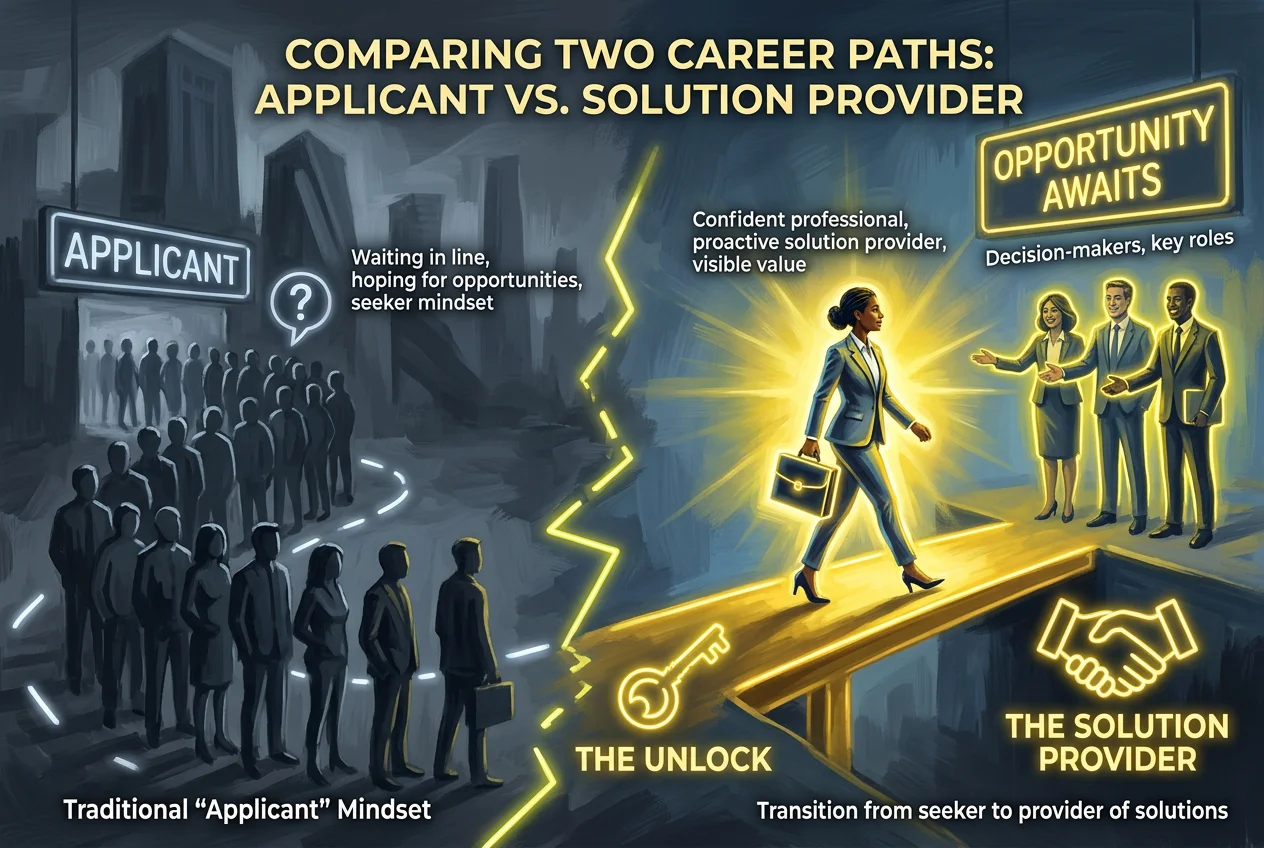
The biggest hurdle in a job search is the "beggar" mindset—the idea that you are asking for a favor. To succeed in a stealth search, you must pivot to a "consultant" mindset. You are a professional with a specific set of skills that can solve a company’s problems, increase their revenue, or save them time.
| Traditional Job Search | Stealth Job Search |
|---|---|
| Reactive (waiting for posts) | Proactive (creating opportunities) |
| High competition (1:500 ratio) | Low competition (1:1 or 1:5 ratio) |
| Focuses on "What can you give me?" | Focuses on "How can I help you?" |
| Relies on HR/ATS | Relies on Hiring Managers/Peers |
| Linear process | Iterative and relationship-based |
Phase 1: Identifying Your Target Market

You cannot search for everything at once. A stealth search requires a laser-focused approach. If you are looking for "any marketing job," you will find nothing. If you are looking for a "Growth Marketing role at a Series B FinTech startup in New York," you can build a map.
Creating Your "Dream 40" List
Start by identifying 40 companies where you would genuinely love to work. Do not check if they have openings. That is irrelevant for now.
- Tier 1 (Top 10): Your absolute dream companies. High-growth, high-prestige, or perfect cultural fit.
- Tier 2 (Next 15): Strong companies in your industry where you have some peripheral connections.
- Tier 3 (Final 15): Companies that are slightly outside your primary niche but where your skills are highly transferable.
Researching the Pain Points
Once you have your list, use tools like Crunchbase, LinkedIn News, and G2 to see what these companies are doing.
- Did they just raise a round of funding? (They will need to scale).
- Are they launching a new product? (They will need marketing and support).
- Are they receiving poor reviews for customer service? (They need operational help).
Phase 2: Optimizing Your Digital Presence for Stealth
Even though you aren't applying through traditional portals, hiring managers will still Google you. Before you start networking, your online presence must be "stealth-ready."
The LinkedIn "Magnet" Profile
Your LinkedIn profile shouldn't be a resume; it should be a landing page.
- Headline: Move beyond "Job Title at Company." Use "Helping [Target Audience] achieve [Result] through [Skillset]."
- About Section: Write in the first person. Tell a story of the problems you’ve solved. Use keywords related to the hidden job market roles you want.
- Featured Section: Upload case studies, slide decks, or links to articles you’ve written. Show, don't just tell.
- Settings: Ensure your "Open to Work" status is set to "Recruiters Only" if you are currently employed. This allows internal recruiters to find you without alerting your current boss.
Building Social Proof
Start engaging with the content posted by employees at your target companies. A simple "Great insight on the new UI update, [Name]!" goes a long way. When you eventually reach out, you won't be a stranger; you'll be a familiar face from their notifications.
Phase 3: Strategic Networking – The Core of the Stealth Search
Networking is the engine of the stealth job search. However, most people do it wrong. They ask for jobs. In a stealth search, you never ask for a job—you ask for information and advice.
The "Three-Layer" Networking Strategy
To penetrate a company’s hidden roles, you need to connect at three levels:
1. The Peers (The Ground Level)
These are people doing the job you want. They know the day-to-day reality and whether the team is overworked (a sign of hiring need).
- Goal: Learn about the culture and the actual tools/processes used.
- Ask: "I’m exploring the [Industry] space and love what your team is doing. Would you be open to a 15-minute chat about your experience there?"
2. The Hiring Managers (The Decision Makers)
These are the people who have the power to create a role or bypass HR.
- Goal: Understand their business challenges and position yourself as a solution.
- Ask: "I’ve been following [Company]’s growth in [Sector]. I have some ideas on how [Specific Challenge] could be addressed based on my work at [Previous Company]. Would you be open to a brief exchange?"
3. The Connectors (The Gatekeepers)
These are people in the industry who seem to know everyone—recruiters, venture capitalists, or industry influencers.
- Goal: Get onto their radar so they think of you when they hear of "unlisted" needs.
Phase 4: Mastering the Informational Interview
The informational interview is the "Trojan Horse" of the hidden job market. It is a low-pressure meeting where you gather intelligence and prepare for common interview questions in a more relaxed setting. To sharpen your approach, you can use CareerBoom.ai to simulate these conversations and refine your answers based on the specific industry pain points you've uncovered during your research.
The Anatomy of a Successful Meeting
To ensure you don't make body language mistakes that could undermine your professionalism, follow these rules:
- The 20-Minute Rule: Respect their time. Never go over 20 minutes unless they insist.
- The Research: Never ask a question that can be answered by a Google search.
- The "Magic Questions":
- "What is the biggest challenge your team is facing in the next six months?"
- "If you could hire someone to take one major project off your plate, what would that project be?"
- "How does the company typically find talent for your team?"
- "Who else should I be talking to as I learn more about this space?"
The Pivot
If the conversation is going well and they mention a challenge that matches your skills, this is your moment to pivot:
"That’s interesting you mention the struggle with customer churn. At my last role, I implemented a predictive model that reduced churn by 15%. I’d love to send over a brief outline of how we structured that, if it would be helpful?"
Now, you aren't a job seeker; you are a valuable resource.
Phase 5: Direct Outreach and Cold Emailing
Sometimes, there is no one to introduce you. In the job search, cold outreach is a superpower. The key is personalization and brevity to hook recruiters from the very first line.
The "Bridge" Email Template
A "Bridge" email connects your past success to their current needs.
Subject: Question regarding [Company Name]'s [Specific Department] strategy
Body: Hi [Hiring Manager Name],
I’ve been following [Company Name]’s recent move into [Specific Market], and I was particularly impressed by [Specific Detail].
I’m reaching out because I recently led a similar transition at [Previous Company], where we [Specific Achievement - e.g., increased revenue by 20%]. Given your current trajectory, I imagine you might be looking for ways to [Solve a specific problem].
I’m not looking for a formal interview right now, but I’d love to share two or three "lessons learned" from my experience that might save your team some time.
Do you have 10 minutes next Tuesday or Wednesday for a brief chat?
Best, [Your Name] [Link to Portfolio/LinkedIn]
Why This Works
- It’s not a resume dump: You aren't asking them to read a boring document.
- It offers value: You are offering "lessons learned."
- It’s specific: It shows you’ve done your homework.
Phase 6: Leveraging Recruiters as Strategic Partners
External recruiters (headhunters) are the primary occupants of the hidden job market. Companies pay them high fees to find candidates for roles that aren't posted.
How to Get on a Recruiter’s "Shortlist"
- Don't just send a resume: Send a "Blurb." A blurb is a 3-4 sentence summary of who you are, what you’ve done, and exactly what you want next. It makes the recruiter’s job easy—they can just copy and paste it to their clients.
- Be clear on your "Price": Recruiters hate it when candidates are vague about salary. Being upfront helps them slot you into the right unlisted roles.
- Check-in monthly: A simple "Hi [Recruiter], just wanted to share that I recently finished [Project]. Still interested in [Role Type] if anything comes across your desk" keeps you top of mind.
Phase 7: Staying Organized and Persistent
A stealth job search is a marathon, not a sprint. Because you are building relationships, the "sales cycle" is longer. You need a system to track your progress.
The Stealth Search Tracker
Use a CRM tool (like Trello, Notion, or a simple Excel sheet) to track:
- Company Name
- Target Contact(s)
- Last Contact Date
- Status (e.g., "Initial Outreach," "Informational Interview Scheduled," "Follow-up Sent")
- Key Intelligence (e.g., "They are switching to AWS in Q3," "Manager loves marathon running")
For a more integrated approach, CareerBoom.ai offers a centralized application tracking dashboard that allows you to manage these high-touch interactions alongside AI-driven tools for resume alignment and interview preparation.
The Power of the "Circle Back"
Most opportunities in the hidden job market are found in the follow-up. If a manager says, "We don't have budget right now," don't disappear. Set a reminder to check in three months later.
"Hi [Name], I saw that [Company] just launched [New Feature]. Congrats! When we spoke in January, you mentioned budget might open up in the Spring. I’ve since completed [New Certification/Project] and would love to revisit our conversation."
Advanced Tactics: Creating Your Own Role
The ultimate "stealth" move is creating your own role by convincing a company to hire you for a role that didn't exist until you suggested it. This happens more often than you think, especially in startups and mid-sized firms.
The Value Proposition Document
If you identify a significant gap in a company’s operations during your networking phase, you can create a "Value Prop" document. This is a 2-page proposal that outlines:
- The Problem: (e.g., "Your social media engagement is lagging behind competitors X and Y.")
- The Solution: (e.g., "A dedicated Content Strategy focused on short-form video.")
- The Evidence: (e.g., "How I grew [Previous Company]'s TikTok to 50k followers in 4 months.")
- The ROI: (e.g., "This strategy will likely result in a 30% decrease in Customer Acquisition Cost.")
By presenting this to a hiring manager, you aren't asking for a job; you are proposing a business partnership.
Overcoming Common Stealth Search Challenges
"I don't have a network."
Everyone has a network. Your network isn't just former bosses; it’s alumni from your school, people in your local hobby groups, and even people you interact with on professional forums. Start where you are. Use the "Alumni" tool on LinkedIn to find people who share a common background—this is the easiest way to get an initial "yes" for a meeting.
"I feel like I'm bothering people."
If you offer value, you aren't bothering them. Most professionals enjoy talking about their work and helping others, provided the request is specific and respectful. If someone doesn't respond, it’s rarely personal; they are simply busy.
"How do I do this while working a full-time job?"
How do I do this while working a full-time job? The stealth search is actually better for those currently employed. Because it relies on high-quality interactions rather than high-volume applications, you can do it in 5 hours a week. Spend 30 minutes a morning on LinkedIn engagement and use your lunch breaks for 15-minute "coffee chats" (virtual or physical).
Tools to Fuel Your Stealth Job Search
To find the unlisted roles, you need the right "spy gear."
| Tool | Purpose |
|---|---|
| CareerBoom.ai | A complete AI-powered platform to align your materials with target roles and track your entire search pipeline. |
| Hunter.io | Find the direct email address of any hiring manager. |
| Crystal Knows | Uses AI to analyze a LinkedIn profile and tell you how to communicate with that person (e.g., "Be brief and data-driven"). |
| Apollo.io | A massive database to find companies by revenue, headcount, and recent hires. |
| Otter.ai | Record and transcribe your informational interviews so you can focus on the conversation. |
| Loom | Send a personalized video message instead of a cold email to stand out. |
Conclusion: The Long Game of Career Success
 The hidden job market is not a "quick fix." It requires more effort upfront than clicking a "Quick Apply" button to achieve long-term career success. It requires courage to reach out to strangers and the discipline to maintain relationships over months.
However, the rewards are incomparable. By mastering the stealth job search, you:
- Eliminate 90% of your competition.
- Negotiate from a position of strength (since they aren't comparing you to 10 other finalists).
- Find roles that are perfectly tailored to your unique strengths.
- Build a professional network that will support your career for decades, not just for your next move.
Stop waiting for the "perfect" job to be posted. The perfect job is already out there, hidden behind a conversation you haven't had yet. It's time to stop applying and start connecting. Your next role isn't on a job board—it's in your network.
Summary Checklist for Your Stealth Search
To ensure you are fully implementing these strategies, use this checklist:
- Define your "Dream 40" list of companies based on research, not just fame.
- Optimize your LinkedIn profile to act as a solution-oriented landing page.
- Identify 3 contacts at each target company (Peer, Manager, Connector).
- Conduct at least two informational interviews per week.
- Send personalized "Value-First" outreach to hiring managers.
- Track every interaction in a dedicated CRM or spreadsheet.
- Follow up with every contact at least once every 3 months with a value-add update.
- Develop a "Value Proposition" for your top 3 dream roles.
By following this structured approach to the job search, you move from being a passive observer of the market to an active architect of your own career. The stealth search is the most powerful tool in a modern professional's arsenal. Use it wisely, and the "hidden" opportunities will soon become your reality.
Frequently Asked Questions
Quick answers to common questions
1
What is the hidden job market and how large is it?
The hidden job market refers to professional roles that are filled through internal promotions, referrals, or direct outreach without ever being publicly advertised. Industry experts estimate that 70% to 85% of all jobs exist in this "stealth" market rather than on traditional job boards like LinkedIn or Indeed.
2
How can I find jobs that aren't posted online?
To access unlisted roles, you must shift from a reactive to a proactive strategy:
- Create a "Dream 40" list of target companies.
- Identify hiring managers and peers at those firms.
- Conduct informational interviews to learn about company pain points.
- Use tools like CareerBoom.ai to track your networking pipeline and align your profile with unlisted needs.
3
What is a stealth job search strategy?
A stealth job search is a relationship-based approach to career advancement. Instead of applying to open postings, you position yourself as a solution provider by building connections with decision-makers before a role is officially created, effectively bypassing the digital gatekeepers of Applicant Tracking Systems (ATS).
4
Why do employers prefer the hidden job market over job boards?
Companies often keep roles "stealth" to:
- Reduce costs: Public postings attract thousands of resumes that require hours to filter.
- Minimize risk: Managers prefer referrals, which have higher retention rates.
- Maintain confidentiality: Some roles involve replacing current staff or sensitive department expansions.
5
How do I ask for an informational interview without being annoying?
The key is a "value-first" approach. Instead of asking for a job, ask for 15 minutes of advice or insight regarding a specific industry challenge. Respect their time by following the 20-minute rule and researching the person thoroughly beforehand so you don't ask questions that can be answered by a simple Google search.
6
Can I conduct a stealth job search while currently employed?
Yes, a stealth search is ideal for those currently employed because it focuses on high-quality, low-volume interactions. To remain discreet:
- Set your LinkedIn "Open to Work" status to Recruiters Only.
- Use lunch breaks for virtual coffee chats.
- Focus on building long-term relationships rather than mass-applying to public portals.
7
How do I create my own job role at a company?
You can create a role by presenting a Value Proposition document. This is a brief proposal that identifies a specific gap in a company's operations (e.g., lagging social engagement) and outlines how your skills will solve that problem and provide a clear Return on Investment (ROI) for the business.
Was this article helpful?
Table of Contents
Understanding the Hidden Job Market: Why It Exists
The Mindset Shift: From Applicant to Solution Provider
Phase 1: Identifying Your Target Market
Phase 2: Optimizing Your Digital Presence for Stealth
Phase 3: Strategic Networking – The Core of the Stealth Search
Phase 4: Mastering the Informational Interview
Phase 5: Direct Outreach and Cold Emailing
Phase 6: Leveraging Recruiters as Strategic Partners
Phase 7: Staying Organized and Persistent
Advanced Tactics: Creating Your Own Role
Overcoming Common Stealth Search Challenges
Tools to Fuel Your Stealth Job Search
Conclusion: The Long Game of Career Success
Summary Checklist for Your Stealth Search
1What is the hidden job market and how large is it?
2How can I find jobs that aren't posted online?
3What is a stealth job search strategy?
4Why do employers prefer the hidden job market over job boards?
5How do I ask for an informational interview without being annoying?
6Can I conduct a stealth job search while currently employed?
7How do I create my own job role at a company?
Share this article
Other articles

40 LinkedIn Tips and Tricks You Should Use in 2026
Master LinkedIn's algorithm, optimize your profile, and accelerate your career with these proven strategies

How to Skyrocket Your Career: 5 Secrets Nobody Tells You
Uncover the hidden strategies to accelerate your professional growth and unlock rapid promotions in any industry, even if you feel stuck.

Skip the Line: 5 Shocking Career Hacks for Rapid Advancement You Need Now
Discover counter-intuitive strategies and powerful shortcuts that can propel your career forward faster than you ever imagined possible.