The Shocking Number of Job Applications It Actually Takes to Get Hired Today
Discover the job hunt strategy and job search tips you need to master the hiring process.
5 months ago - Updated 3 months ago

The modern job search can feel like sending messages into a deep, dark void. You spend hours adjusting your resume, writing resume drafts, crafting the perfect cover letter, and filling out endless online forms on job boards, only to receive a generic automated rejection email—or worse, absolute silence.
If you feel like you are applying to more jobs than ever before with fewer results, you aren't imagining things. The landscape of recruitment has fundamentally shifted. The days of sending out five tailored resumes and landing three interviews are long gone.
In this comprehensive guide, we are going to break down the cold, hard math of the modern job market. We will explore the shocking job applications count it actually takes to secure a job offer today, why the system has become so competitive, and how you can transform your job search strategies and overall job hunt strategy to beat the odds without burning yourself out.
The Cold, Hard Numbers: The 2026 Hiring Funnel
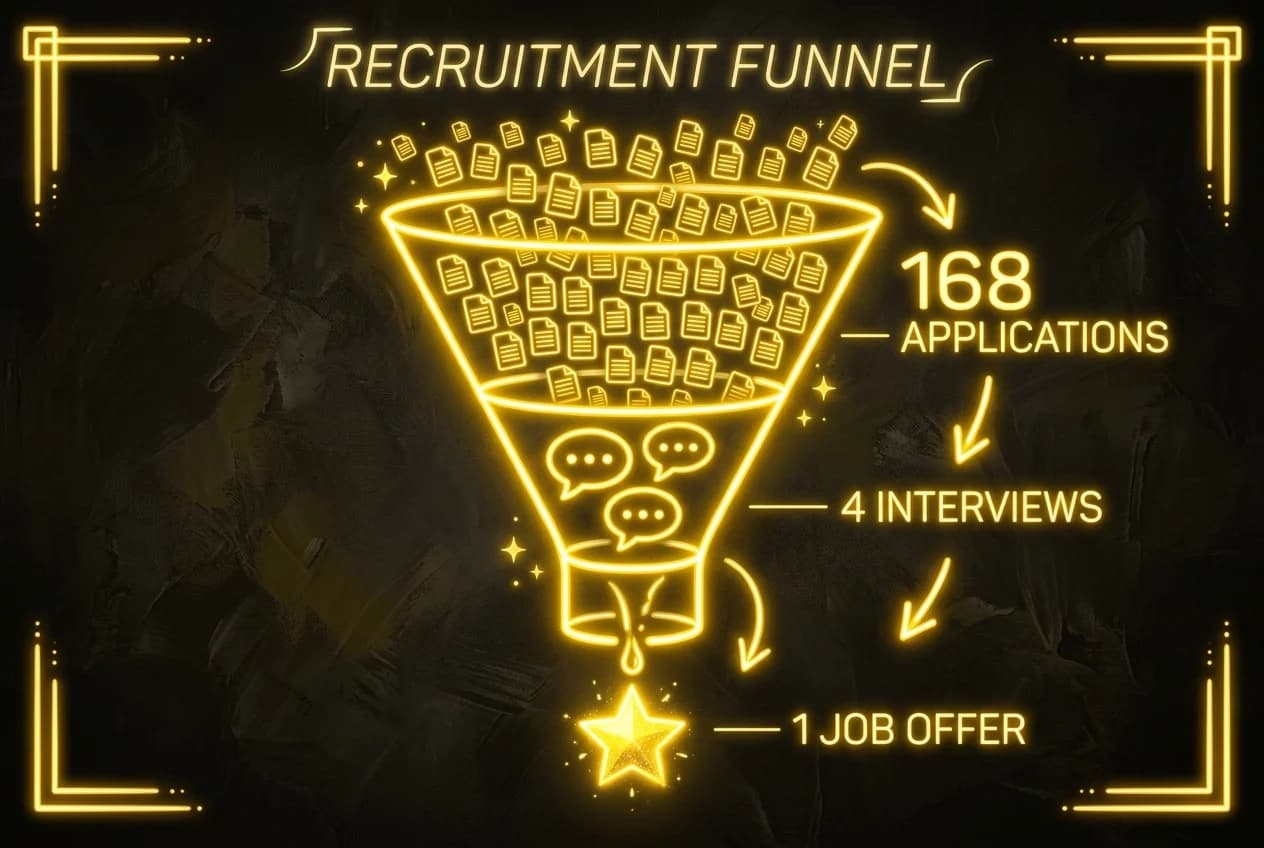
To understand how to get hired today, you first need to look at the corporate hiring process as a sales funnel. Just like a business must pitch to hundreds of prospects to close a handful of deals, a job seeker must pass through several distinct "gates" before landing a single offer.
According to consolidated recruiting productivity benchmarks and job-seeker surveys, the modern hiring funnel looks like this:
| Funnel Stage | Average Conversion Rate | What It Means in Real Numbers |
|---|---|---|
| Application to Recruiter Screen | 2% – 5% | Out of 100 applications, only 2 to 5 will result in an initial recruiter phone screening call. |
| Screen to Hiring Manager Interview | 20% – 30% | Out of those 5 screens, only 1 or 2 candidates will move forward to meet the actual team. |
| Hiring Manager to Final Round | 25% – 35% | Only the top 2-3 candidates make it to the final presentation or panel interview. |
| Final Round to Job Offer | 25% – 30% | Typically, one person out of the final group receives the offer. |
The Real Math: How Many Applications for One Offer?
Let's look at the aggregate data. Across all industries, the average job seeker needs to submit roughly 42 applications to secure just one interview.
Because the average interview-to-offer conversion rate sits at roughly 25% (meaning you need to interview for 4 different roles to get one offer), the math is simple but sobering:
$$\text{42 applications per interview} \times \text{4 interviews} = \mathbf{168\text{ applications}}$$
On average, it takes 100 to 180+ job applications to land a single, solid job offer in today's market.
[ 168 Applications Submitted ]
              │
              ▼ (2.4% conversion)
     [ 4 First-Round Interviews ]
              │
              ▼ (25% conversion)
         [ 1 Job Offer ]
However, this number is highly bimodal. It varies wildly depending on your industry, experience level, and geographic location:
- Entry-Level & Recent Graduates: Often face the steepest volume requirements, frequently needing 150 to 200+ applications to land their first professional role.
- Highly Competitive Sectors (e.g., Tech & Marketing): Due to recent layoffs and market saturation, tech professionals report an average search time of 9.7 months and often submit 200 to 400+ applications before landing an offer.
- Niche or High-Demand Roles (e.g., Specialized Healthcare, Trade Skills): These candidates may only need 10 to 30 targeted applications because their skills are in critically short supply.
The Reality Check: Nearly half (48%) of all active job seekers now expect to submit at least 100 applications before landing a position, and 73% report that their job search is significantly harder than in previous years.
Why Is the Modern Job Market So Brutal?

To fix your job search, you must first understand why the job applications count has skyrocketed. The system isn't necessarily broken, but it has been completely transformed by technology and shifting employer behaviors.
1. The Rise of "One-Click" Apply and AI Noise
The ease of applying to jobs has created a massive volume problem. Platforms like LinkedIn, Indeed, and ZipRecruiter—the most popular job search websites and job search sites—allow candidates to apply to dozens of roles a day with a single click. Furthermore, the rise of AI auto-apply tools has made it possible for candidates to apply to hundreds of jobs overnight on various online job boards.
While this sounds convenient for job seekers, it has backfired. Because everyone is applying to everything, corporate job postings now attract an average of 250+ applications per role—a number that has doubled since 2022. Recruiters are completely drowned in noise, making them rely even more heavily on automated filters to slash the pile.
2. The ATS "Black Hole"
To cope with the hundreds of resumes submitted for every single opening, 98% of Fortune 500 companies (and a growing majority of mid-sized businesses) use an Applicant Tracking System (ATS).
These systems scan resumes for specific keywords, years of experience, and formatting. If you do not run your CV through an ats resume checker or ats checker to optimize your resume score or resume scoring, your resume is highly likely to be automatically sorted into the "do not pursue" pile before a human eye ever sees it. Studies show that up to 75% of resumes are filtered out by the ATS.
3. Corporate Hesitancy and "Ghost Jobs"
According to recent talent market trends, hiring timelines have stretched significantly, with the average time-to-hire now hovering around 42 days. Employers are operating in a cautious economic landscape. They are slow to make decisions, adding extra rounds of interviews, take-home assignments, and personality assessments.
Additionally, many listings online are "ghost jobs"—postings that companies keep active on job listing websites, job postings websites, and job finder sites to build a pipeline of future talent, project an image of growth, or placate overworked staff, even though they have no immediate intention of hiring. Applying to these roles contributes to your application count but has a 0% chance of yielding an interview.
The Ultimate Dilemma: Quality vs. Quantity

When faced with these daunting statistics, job seekers usually fall into one of two traps:
Trap A: The "Spray and Pray" Method (Pure Quantity)
Desperate for results, these job seekers often resort to rage applying, treating the job search like a pure lottery. They upload a single, generic resume template or cv template and click "Easy Apply" on 50 jobs a day.
- The Result: A near-zero success rate (often less than 0.1%). Because the resume isn't tailored to any specific job description, it gets systematically rejected by every ATS. This leads to severe job search burnout, fatigue, and a feeling of hopelessness.
Trap B: The "Hyper-Targeted" Method (Pure Quality)
On the other end of the spectrum, some job seekers spend 2 to 3 hours meticulously tailoring their resume for every single application, treating resume writing as an exhaustive manual chore.
- The Result: While their conversion rate is higher, their overall volume is too low. If it takes 44 minutes on average to submit a single high-quality application, applying to 100 jobs would require over 73 hours of highly focused labor. In a market where even great candidates get ghosted, relying on just 5 or 10 applications a month leaves too much to chance.
Finding the Sweet Spot
Data shows that the "sweet spot" for manual job hunting is between 21 and 80 highly customized applications. This volume is large enough to give you a statistically viable chance of landing an interview, yet small enough that you can maintain a high standard of quality for each submission.
                     [ THE JOB SEARCH SPECTRUM ]

     Low Quality                                         High Quality
     High Volume                                         Low Volume
  ┌───────────────────────┬────────────────────────┬─────────────────────┐
  │   "Spray & Pray"      │      "The Sweet Spot"  │   "Hyper-Targeted"  │
  │   • 500+ generic apps │      • 21-80 tailored  │   • <10 highly      │
  │   • ATS rejections    │        applications    │     customized apps │
  │   • Burnout           │      • High conversion │   • High effort,    │
  │                       │      • Sustainable     │     low statistical │
  │                       │        pace            │     probability     │
  └───────────────────────┴────────────────────────┴─────────────────────┘
But how do you scale this customized approach when you are competing against thousands of other applicants on job hunting sites and the best job search engines? How do you send hundreds of tailored applications without spending every waking hour staring at a screen?
Scaling Quality: How CareerBoom.ai Solves the Job Search Paradox
This is where modern technology can work for you instead of against you. To win in today's job market, you need a tool that bridges the gap between massive volume and hyper-personalization.
CareerBoom.ai is designed to solve this exact bottleneck. As an advanced ai resume builder and resume creator, CareerBoom.ai acts as the ultimate free resume builder and resume maker that helps you create a resume and build a resume that bridges the gap between the low success rate of mass-applying and the exhausting time commitment of manual tailoring. It automates the entire process by aligning your resume and cover letter with specific job descriptions.
Manual Search:   [ Find Job ] ──► [ Tailor Resume (45m) ] ──► [ Apply ]  (Repeat 150x)
CareerBoom.ai:   [ Set Profile ] ──► [ Auto-Tailor & Apply to 100s of Jobs Simultaneously ]
How CareerBoom.ai Works
- Deep Profile Integration: You upload your core resume, select from professionally designed resume templates and cv templates, and input your target job preferences.
- AI-Powered Tailoring: CareerBoom.ai's intelligent engine automatically analyzes every single job posting you target. It serves as a personal resume builder that matches your skills directly to the job description, adjusting keywords and phrasing so your application bypasses the ATS and stands out to recruiters.
- Automated Application Deployment: Instead of spending hours filling out repetitive forms, CareerBoom.ai automatically submits these highly tailored applications on your behalf.
By sending hundreds of beautifully customized applications automatically, CareerBoom.ai drastically increases your probability of getting an interview and, ultimately, a job offer. It gives you the raw volume of the "spray and pray" method but preserves the elite conversion rates of a hyper-targeted, manual search.
Instead of spending 70+ hours tailoring resumes, you can focus your energy on what humans do best: preparing for interviews, building genuine relationships, and negotiating your final offer.
Actionable Playbook: How to Lower Your Application Count
Whether you choose to automate your search or handle it manually, implementing these proven job search tips, job hunting tips, and strategic adjustments will immediately improve your application-to-interview conversion rate.
1. Master the ATS-Friendly Resume Format
If your resume isn't formatted correctly, human eyes will never see it. Using a proven resume format or an ats friendly resume format is essential to keep your layout clean, structured, and simple. You can easily achieve this by starting with an ats friendly resume template or an ats friendly cv template:
- Avoid Complex Formatting: Do not use tables, text boxes, graphics, icons, or multi-column layouts. These are classic hallmarks of bad resume examples that get auto-rejected, even if you used a high-quality ats resume template.
- Use Standard Headings: Stick to universal terms like "Work Experience," "Education," and "Skills." Do not get creative with headings like "Where I've Been" or "My Superpowers."
- Submit as a PDF or DOCX: While most modern ATS can handle PDFs, some older systems still prefer
.docxfiles. If a job portal explicitly requests a specific format, follow those instructions precisely. - Match Keywords Naturally: Look at the "Requirements" and "Responsibilities" sections of the job posting. If they ask for "Project Management" and your resume says "Project Coordination," change it to match their exact phrasing.
2. Shift to Skills-Based Framing
The credential-first era is fading. Today, 94% of organizations report that skills-based hiring is more predictive of job success than traditional resume reviews or prestigious degrees.
To write resume content that actually gets noticed, you must shift your focus. Instead of just listing your past duties, focus on your skills and the tangible outcomes they produced to build a perfect resume. While the star interview technique is typically used to answer star interview questions during the hiring process, you can also use it to structure your achievements when writing resume bullet points:
Weak (Duty-focused): "Responsible for managing the company social media accounts and writing blog posts."
Strong (Skills & Results-focused): "Spearheaded a content marketing initiative that grew organic social media traffic by 45% over six months, leveraging SEO keyword optimization and data-driven audience targeting."
3. Track Your Personal Funnel Metrics
If you do not track your data, you cannot optimize your search. You can use a simple job application template spreadsheet, or use the centralized dashboard on CareerBoom.ai to track job applications, monitor your progress, and manage your pipeline in one place:
[ Application Date ] ──► [ Company/Role ] ──► [ Status (Applied/Screen/Interview/Rejected) ]
Analyze your metrics every two weeks:
- If your Application-to-Interview rate is under 3%: Your resume or targeting is the issue. The ATS is filtering you out, or you are applying to roles for which you are under- or over-qualified. Focus on better keyword alignment and tailoring.
- If you get Recruiter Screens but no Hiring Manager Interviews: Your phone screening presentation needs work. Practice your elevator pitch, review common job interview questions (and other common interview questions), and make sure you can explain your career transition or background clearly and concisely by following expert interview tips.
- If you get Final Interviews but no Offers: You are highly qualified, but you need to polish your behavioral interviewing skills, presentation style, or cultural alignment.
4. Apply Early (The 48-Hour Rule)
Recruiters are often overwhelmed by applications within the first few days of a posting. Many will stop looking at new resumes once they have a pool of 10 to 15 qualified candidates to screen.
Make it a habit to leverage instant job alerts on your favorite job listing site to check for new postings daily and aim to get your application in within the first 24 to 48 hours of a job going live. This simple timing adjustment can double your chances of being reviewed.
5. Leverage the Power of Referrals
While applying online is necessary, it should not be your only channel. A warm job referral makes a candidate 18 times more likely to get hired than a cold applicant from a job board.
Whenever you apply to a company, search LinkedIn to see if you have any first- or second-degree connections who work there. Reach out with a short, polite message:
"Hi [Name], I hope you're doing well! I recently applied for the [Job Title] role at [Company]. I've been following your company's growth and love the work you do. If you have five minutes sometime, I'd love to ask you a couple of questions about your experience working there. No pressure at all, and I appreciate your time!"
The Mental Game: Managing Job Search Burnout
Searching for a job in a highly competitive market is emotionally taxing. When the average search takes upwards of six months, getting professional career advice on how to handle job rejection professionally and maintaining your mental health is just as important as polishing your resume.
Set Sustainable Daily Goals
Do not spend 8 hours a day staring at job boards. This leads to rapid burnout, anxiety, and diminishing returns. Instead, treat your job search like a part-time job with structured, sustainable hours:
- For full-time job seekers: Limit your search to 3 to 4 hours a day. Set a target of 3 to 5 high-quality, targeted applications per day.
- For employed job seekers: Dedicate 1 hour in the evening or morning, aiming for 1 to 2 tailored applications per day.
Focus on What You Can Control
You cannot control the economy, the recruiter's mood, the number of other applicants, or whether a company decides to freeze a role.
You can control:
- How many applications you submit.
- The quality and tailoring of your resume.
- How many networking messages you send.
- How much time you spend learning new skills or resting.
By shifting your mindset from "I must get a job today" to "I will execute my daily strategy today," you protect your mental energy and maintain the stamina needed to cross the finish line.
Summary: A Modern Approach to a Modern Market
The job market has evolved, and the old advice of "just walk in and hand them your resume" or "submit 500 generic applications" no longer works.
Getting hired today requires a blend of job search strategies, precise personalization, and smart automation. While the average job hunter needs to submit between 100 and 180+ applications to secure an offer, you do not have to do all of that heavy lifting manually or pay for expensive resume writing services.
By optimizing your resume for modern ATS systems using an ats friendly resume format, focusing on skills-based achievements, and using advanced platforms like CareerBoom.ai to generate customized cover letter templates and handle the repetitive task of tailoring and submitting applications at scale, you can cut through the noise, bypass the black hole, and land your next great career opportunity in record time.
Your next job is out there. Stop playing the lottery with generic applications, start working smarter, and let modern technology open the doors to your next interview.
Frequently Asked Questions
Quick answers to common questions
On average, it takes 100 to 180+ job applications to land a single job offer. This is because only 2% to 5% of applications result in a recruiter screen, and you typically need to complete 4 separate interviews to secure one offer.
The modern job search is highly competitive due to:
- "One-click" apply tools and AI auto-apply bots that flood job postings with hundreds of resumes.
- Applicant Tracking Systems (ATS), which filter out up to 75% of resumes.
- "Ghost jobs" that companies post but have no immediate plans to fill.
Only about 25% of resumes make it past the Applicant Tracking System (ATS). The remaining 75% are filtered out automatically by software before a human recruiter ever sees them, usually due to formatting issues or missing keywords.
The "sweet spot" is a balance of both. Aim for 21 to 80 highly customized applications.
- Too many (Spray & Pray): Leads to instant ATS rejections and burnout.
- Too few (Hyper-targeted): Lowers your statistical chance of success in a crowded market.
To beat the ATS and get noticed:
- Avoid complex formatting like tables, text boxes, or graphics.
- Match keywords naturally from the job description.
- Apply early (within the first 24 to 48 hours).
- Use AI tools like CareerBoom.ai to auto-tailor your resume.
A referred candidate is 18 times more likely to get hired than a cold applicant from a job board. Networking and securing internal referrals is one of the most effective ways to bypass the ATS and fast-track your job search.
To avoid burnout, set sustainable goals:
- Unemployed: Aim for 3 to 5 high-quality, tailored applications per day.
- Employed: Aim for 1 to 2 tailored applications per day.
- Focus on quality and personalization over raw, uncustomized volume.
Was this article helpful?
Table of Contents
The Cold, Hard Numbers: The 2026 Hiring Funnel
Why Is the Modern Job Market So Brutal?
The Ultimate Dilemma: Quality vs. Quantity
Scaling Quality: How CareerBoom.ai Solves the Job Search Paradox
Actionable Playbook: How to Lower Your Application Count
The Mental Game: Managing Job Search Burnout
Summary: A Modern Approach to a Modern Market
1How many job applications does it take to get hired today?
2Why is it so hard to get a job interview today?
3What percentage of resumes make it past the ATS?
4Is it better to apply to many jobs or a few targeted ones?
5How can I bypass the ATS and get my resume seen?
6How much more likely are you to get hired with a referral?
7How many job applications should I submit per day?
Share this article
Other articles

Best AI Auto-Apply Tools: Automated Job Search Review
We test the leading artificial intelligence platform designed to automate your job applications and land interviews.

10 Best Job Trackers to Organize Your Search in 2026
Streamline your job hunt with the top Chrome extensions and platforms designed to track applications effortlessly.

How to Handle Job Rejection Like a Pro (and Bounce Back Stronger)
Turn setbacks into comebacks with expert advice on processing rejection and refining your job search approach.