Top 10 Job Search Platforms in Austria for 2026
Discover the most effective job boards, local platforms, and niche sites to land your next role in Austria.
1 month ago - Updated 1 month ago

Navigating the job market in Austria requires a blend of local insight, cultural understanding, and the right digital tools. Known for its high quality of life, robust social security system, and stunning landscapes, Austria is an exceptionally attractive destination for both local professionals and international expats. However, much like neighboring job markets in Germany, Switzerland, and the Czech Republic, the Austrian job market is unique, characterized by strict collective bargaining agreements (Kollektivverträge), a strong emphasis on formal qualifications, and a distinct preference for localized recruitment channels.
As we move through 2026, the hiring landscape is undergoing a massive transformation. While recruiters face a highly competitive market, job seekers must adapt to new regulatory changes, such as the implementation of the EU Pay Transparency Directive in June 2026, and the rapid integration of artificial intelligence in applicant sourcing.
To stand out and secure your dream role, you need to know exactly where to look. This comprehensive guide reviews the top 10 job search platforms in Austria for 2026, detailing their strengths, target audiences, and how you can leverage them to land your next position.
Why Your Job Search Strategy in Austria Needs a 2026 Upgrade
Historically, finding a job in Austria meant scrolling through local newspapers or submitting physical application folders. While the market has digitized rapidly, it remains highly fragmented. A single opening might be posted on a niche regional board, a national giant, or exclusively on a company’s internal career page.
For job seekers, this fragmentation presents a major challenge: how do you ensure you aren't missing out on the perfect role without spending five hours a day manually checking dozens of different websites?
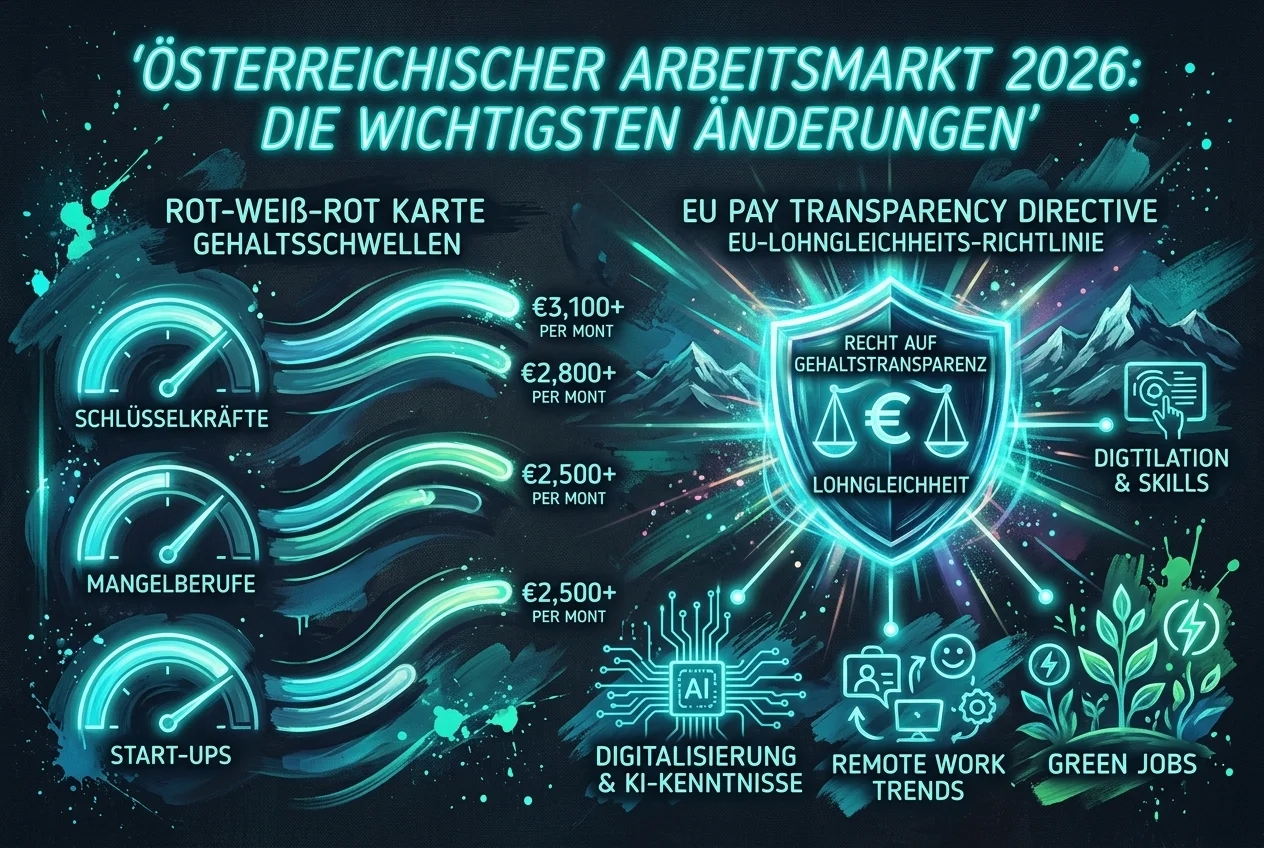
Furthermore, the legal framework of working in Austria has shifted. As of 2026, the minimum salary thresholds for the Red-White-Red Card (the work permit for non-EU citizens) have increased:
- Key Employees: Minimum gross monthly salary of €3,225.
- Other Key Workers: Minimum gross monthly salary of €3,465.
- EU Blue Card: Minimum gross monthly salary of €3,678.57.
Additionally, the EU Pay Transparency Directive, which comes into full effect by June 2026, mandates that employers disclose actual starting salaries or realistic salary ranges prior to interviews, and explicitly bans them from asking about your previous salary history.
To navigate these complex dynamics, smart job seekers are moving away from manual, repetitive applications and turning to advanced, AI-driven aggregation tools.
The Ultimate Solution: CareerBoom.ai

Before diving into the traditional local platforms, it is essential to highlight the most efficient way to search for jobs globally and locally in 2026: CareerBoom.ai.
Rather than requiring you to register on ten different Austrian job boards, upload your CV repeatedly, and write endless cover letters, CareerBoom.ai acts as a centralized command center for your career.
- Global Aggregation: CareerBoom.ai aggregates job listings from over 300,000 websites worldwide, pulling directly from local job boards, corporate career portals, and niche databases.
- Massive Volume: With over 1 million new job postings daily, it ensures you have access to every single open position in Austria the moment it goes live.
- Premium Auto-Apply Feature: CareerBoom's standout premium auto-apply feature automatically finds and applies to highly relevant jobs on your behalf, tailored specifically to your unique profile, skills, and career goals.
- Elite Academic Trust: This cutting-edge automation technology is why CareerBoom is trusted by top-tier university students and alumni from prestigious institutions like Harvard, MIT, and Stanford University to bypass traditional job-hunting friction and land competitive roles.
By combining the reach of every Austrian job board with automated precision, CareerBoom.ai represents the future of job search platforms in 2026.
The Top 10 Job Search Platforms in Austria for 2026
If you want to explore the landscape platform by platform, here are the ten most effective job boards, local portals, and niche sites to accelerate your search to work in Austria.
1. CareerBoom.ai
For those looking to maximize efficiency, CareerBoom.ai is the undisputed top choice. It eliminates the need to visit multiple platforms by bringing the entire Austrian and global job market directly to your screen.
- Target Audience: International expats, highly skilled specialists, corporate professionals, and university graduates.
- Language Focus: Multilingual (excellent for both English-speaking and German-speaking roles).
- How it Works: CareerBoom’s AI engine scans the web to index over 1 million new jobs daily. Its smart filters allow you to isolate Austrian opportunities by region, industry, and remote-work compatibility.
- The Auto-Apply Advantage: The platform's automated application system submits tailored profiles to open roles, ensuring you are always among the first applicants—a critical factor in securing interviews.
Expert Tip: Set up your profile on CareerBoom.ai with highly specific keywords matching Austrian industry standards (such as Kollektivvertrag expectations or specific software skills) to allow the auto-apply feature to target the highest-paying, most relevant roles.
2. karriere.at
As the undisputed local market leader, karriere.at is the household name for job hunting in Austria. Boasting up to 4.5 million monthly visits, it is the first place most Austrian companies post their vacancies.
- Target Audience: White-collar professionals, corporate employees, and specialists across all major industries.
- Language Focus: Primarily German, though the number of English-medium corporate listings is growing.
- Key Features:
- An extensive employer review database (similar to Glassdoor) providing insights into company culture, benefits, and work-life balance.
- An integrated salary calculator based on real Austrian collective bargaining data.
- A highly reliable mobile app and customizable job alerts.
- Pros: Unmatched volume of local listings; highly trusted by Austrian HR managers.
- Cons: Highly competitive; requires a strong command of German to navigate the majority of listings and the interface.
3. AMS eJob-Room
The eJob-Room is the official digital job portal of the Arbeitsmarktservice (AMS), Austria's public employment service. It is the largest public labor marketplace in the country.
- Target Audience: All job seekers in Austria, including blue-collar workers, apprentices, and international candidates seeking visa sponsorship.
- Language Focus: German.
- Key Features:
- Direct connection to the official Austrian unemployment and placement database.
- Completely free of charge for both employers and job seekers.
- Crucial integration for the Red-White-Red Card application process, as many visa categories require a "labor market test" (Arbeitsmarktprüfung) conducted through the AMS.
- Pros: Access to public sector roles, apprenticeships, and regional positions that are rarely advertised on commercial job boards.
- Cons: The user interface is highly bureaucratic and outdated; communication is almost exclusively in German.
4. hokify
If you are looking for a modern, mobile-first approach, hokify is Austria's leading platform for rapid applications. It has revolutionized hiring for trade, service, and entry-level positions.
- Target Audience: Trade professionals, hospitality and gastronomy workers, retail employees, administrative staff, and young professionals.
- Language Focus: German.
- Key Features:
- A "swipe-to-apply" interface that allows users to apply to jobs in under three minutes.
- No requirement for a traditional, formal cover letter—applications are completed via structured in-app queries.
- Strong focus on regional proximity, showing jobs closest to your physical location.
- Pros: Extremely fast application process; highly active in sectors with urgent staffing needs.
- Cons: Not suitable for highly specialized, academic, or executive-level corporate roles.
5. StepStone Austria
Part of the global StepStone Group, StepStone Austria is a premium job board that caters to highly qualified specialists, managers, and corporate professionals.
- Target Audience: Mid-to-senior level professionals, engineers, IT experts, finance specialists, and executives.
- Language Focus: German and English.
- Key Features:
- Excellent employer branding profiles, giving job seekers deep insights into corporate structures and values.
- High-quality salary planner tools that align with 2026 pay transparency standards.
- Smart matching technology that suggests roles based on CV uploads.
- Pros: High-salary roles; professional, clean interface; excellent for corporate careers.
- Cons: Lower total volume of listings compared to karriere.at; highly selective application processes.
6. Willhaben Jobs
While internationally known as a classifieds marketplace (similar to Craigslist or eBay Kleinanzeigen), Willhaben hosts one of the most active and popular regional job boards in Austria.
- Target Audience: Local tradespeople, administrative assistants, regional workers, and employees of small-and-medium-sized enterprises (SMEs).
- Language Focus: German.
- Key Features:
- Incredibly precise geographical filtering, down to specific postal codes and small villages.
- Direct, informal communication channels with local business owners.
- A massive variety of part-time (Teilzeit) and marginal (Geringfügig) employment options.
- Pros: Excellent for finding jobs outside of major metropolitan areas like Vienna or Graz; less formal application hurdles.
- Cons: Very few corporate, international, or high-paying tech roles; English listings are virtually non-existent.
7. LinkedIn Austria
As the global gold standard for professional networking, LinkedIn is highly active in Austria, particularly within Vienna, Linz, and Salzburg.
- Target Audience: Corporate professionals, tech workers, multinational executives, and creative industry specialists.
- Language Focus: English and German.
- Key Features:
- Direct networking opportunities with HR managers, internal recruiters, and team leads.
- "Easy Apply" features that streamline the submission process.
- Comprehensive professional profile that acts as an active, living CV.
- Pros: The absolute best platform for finding English-speaking roles and international companies operating in Austria; crucial for passive job hunting (letting recruiters find you).
- Cons: Highly competitive; heavily saturated with global applicants; less effective for traditional Austrian SMEs or regional trade roles.
8. Indeed Austria
Operating as a highly efficient generalist search engine, Indeed Austria indexes listings from thousands of corporate websites, career portals, and recruitment agencies across the country.
- Target Audience: Broad demographic, from entry-level workers to experienced specialists.
- Language Focus: German and English.
- Key Features:
- Simple, keyword-based search interface.
- Aggregated reviews of local employers.
- The option to upload a CV and allow employers to contact you directly.
- Pros: Massive database of listings; covers almost every industry and region in Austria.
- Cons: The interface can feel cluttered; contains duplicate postings; search results sometimes include expired listings.
9. metajob.at
METAJOB is a highly powerful Austrian meta-search engine that crawls the web to collect job listings from corporate pages, local newspapers, and smaller regional portals.
- Target Audience: Job seekers looking for "hidden" roles that aren't advertised on expensive commercial job boards.
- Language Focus: German.
- Key Features:
- Crawls over thousands of Austrian company career pages daily.
- Clean, no-nonsense search interface focused purely on keywords and location.
- Excellent regional coverage, including highly specific local Austrian companies.
- Pros: Helps you discover roles directly on company websites that competitors might miss.
- Cons: No built-in application portal (redirects you to external sites); lacks advanced career advice or salary tools.
10. derStandard.at/Karriere
The career portal of Der Standard—one of Austria's most respected national daily newspapers—is highly regarded as a premium platform for academic, creative, and public-sector positions.
- Target Audience: Academics, researchers, public sector workers, NGO staff, designers, journalists, and cultural professionals.
- Language Focus: Primarily German, with some English academic and research roles.
- Key Features:
- Curated listings from highly reputable institutions, universities, and cultural organizations.
- High-quality editorial content covering career development, labor laws, and workplace culture in Austria.
- Pros: Highly prestigious listings; excellent for non-profit, educational, and creative sectors.
- Cons: Limited opportunities for traditional corporate, trade, or high-volume sales roles.
Strategic Comparison: Austria Job Boards
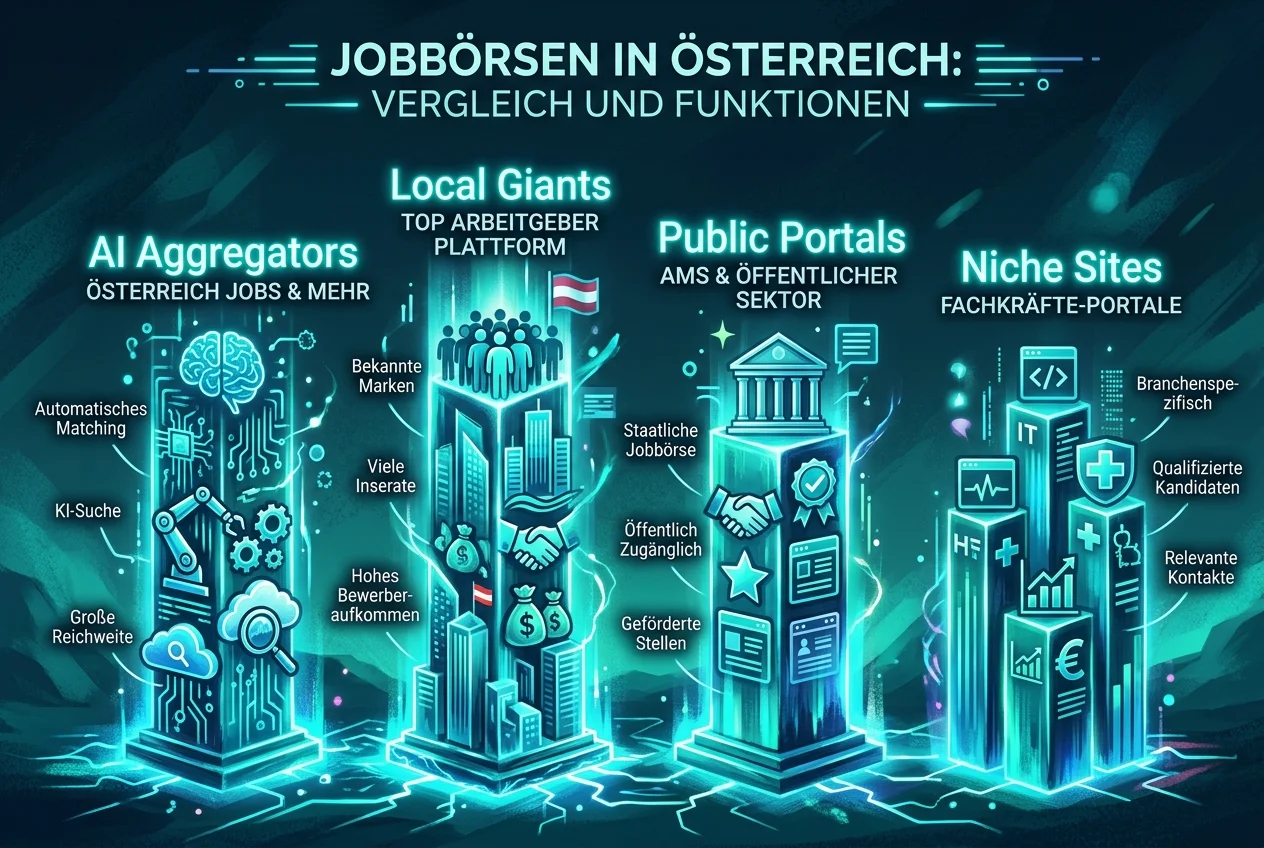
To help you decide where to focus your efforts, the table below compares the key attributes of the top job search platforms in Austria for 2026.
| Platform | Primary Target Audience | Language Focus | Key Advantage | Best For |
|---|---|---|---|---|
| CareerBoom.ai | Global & local professionals | Multilingual | Aggregates 300k+ sites; premium auto-apply feature | Maximum efficiency & international candidates |
| karriere.at | Corporate & white-collar | German | Market leader with 4.5M monthly visits; rich local data | Mid-to-senior local roles |
| AMS eJob-Room | General workforce & visa seekers | German | Official government portal; crucial for RWR Card | Public sector, apprenticeships, & visa verification |
| hokify | Trade, retail, & hospitality | German | Swipe-to-apply mobile interface; no cover letters | Quick applications & service industry |
| StepStone Austria | Specialists & executives | German / English | Premium employer branding & high-salary insights | Corporate careers & management |
| Willhaben Jobs | Regional workers & local SMEs | German | Hyper-local filtering down to postal codes | Regional employment & small businesses |
| LinkedIn Austria | Tech, corporate, & multinationals | English / German | Direct networking & headhunter visibility | Expats & multinational corporations |
| Indeed Austria | General job seekers | German / English | High-volume aggregation across all sectors | Broad, comprehensive searches |
| metajob.at | General job seekers | German | Indexes "hidden" jobs directly from company sites | Finding direct corporate listings |
| derStandard Jobs | Academics, creatives, & NGOs | German | Prestigious, highly curated listings | Research, public sector, & creative roles |
Essential Rules for Landing a Job in Austria in 2026
Successfully landing a role in Austria requires more than just submitting a great CV. You must understand the unique legal, cultural, and structural components of the Austrian employment landscape.
1. Master the "Kollektivvertrag" (Collective Bargaining Agreement)
In Austria, approximately 98% of employees are covered by a Collective Bargaining Agreement (Kollektivvertrag or KV). These legally binding agreements are negotiated annually between trade unions and employers' associations for specific industries (e.g., IT, metalworking, retail).
The KV dictates:
- Minimum Salaries: Every job posting in Austria must legally state the minimum gross salary according to the applicable collective agreement.
- The 14-Salary System: In Austria, your annual salary is typically split into 14 payments rather than 12. You receive your regular monthly salary, plus a "13th-month salary" (holiday bonus or Urlaubsgeld in June) and a "14th-month salary" (Christmas bonus or Weihnachtsgeld in November). Both bonuses are taxed at a significantly lower rate.
- Overtime and Working Hours: Strict regulations govern maximum working hours and overtime compensation.
Crucial 2026 Update: Under the newly implemented EU Pay Transparency Directive, employers are now required to disclose the actual expected salary or realistic range, rather than just copying and pasting the absolute minimum KV rate. This makes it much easier for job seekers to apply salary negotiation secrets to secure the compensation they deserve.
2. Tailor Your "Lebenslauf" (CV) to Austrian Standards
Austrian HR departments are notoriously traditional when it comes to CV formatting. To ensure your application isn't filtered out, you should tailor your resume and adhere to these guidelines. Utilizing CareerBoom.ai to automatically align your CV and cover letter with the specific keywords of the job description is an easy way to meet these strict requirements while saving time.
- The Photo: Unlike in the UK or US, including a professional, high-quality headshot on your CV is still highly common and expected in Austria. If you do not have a corporate portrait, you can use CareerBoom.ai to generate professional AI headshots that align with local standards.
- Structure and Chronology: Use a reverse-chronological layout. Keep it concise, structured, and focused on concrete achievements.
- Degrees and Certifications: Austrians place immense value on formal titles (e.g., BSc, MSc, DI, Dr.). If you have a degree, list it prominently alongside your name. Always attach copies of your university degrees, references, and professional certifications (Dienstzeugnisse) to your application.
- Language: If the job description is written in German, your CV and cover letter must be in German. If it is in English, an English application is perfectly acceptable.
3. Navigating the Red-White-Red Card (RWR Card)
If you are a non-EU/EEA citizen looking to work in Austria, you will likely need to apply for the Red-White-Red Card. This is a points-based residence and work permit that binds you to a specific employer for 24 months. To find qualifying roles, you can browse the Work in Austria job board, which features positions open to international talent.
To qualify, you must collect points based on criteria such as age, work experience, language skills (German or English), and education. As of 2026, you must also meet the updated minimum gross monthly salary requirements:
+-----------------------------+-----------------------------+
| RWR Card Category           | 2026 Minimum Gross Monthly  |
+-----------------------------+-----------------------------+
| Key Employees               | €3,225                      |
| Other Key Workers           | €3,465                      |
| EU Blue Card                | €3,678.57                   |
+-----------------------------+-----------------------------+
Note: These thresholds are updated annually to match economic adjustments. Always verify the latest requirements on the official Austrian migration portal (migration.gv.at) before submitting your visa application. You can also consult the Austrian Business Agency for professional assistance with immigration and settlement procedures.
Actionable Tips to Accelerate Your Austrian Job Search
To maximize your chances of success in the competitive 2026 Austrian job market, follow this step-by-step strategic approach:
Step 1: Automate the Heavy Lifting
Don't waste valuable hours manually searching and applying on multiple platforms. Use CareerBoom.ai to aggregate listings from all major Austria job boards (including karriere.at, StepStone, and regional sites) and set up the premium auto-apply feature to submit highly targeted applications instantly.
Step 2: Optimize Your LinkedIn Profile
Many Austrian headhunters actively source candidates on LinkedIn, especially for tech, engineering, and corporate roles. Ensure your profile is fully optimized with relevant keywords using proven LinkedIn tips, set your location preference to Austria, and toggle the "Open to Work" feature for recruiters.
Step 3: Tap into "Vitamin B"
In Austria, networking is colloquially referred to as "Vitamin B" (Beziehungen / relationships). Many of the best roles are filled through personal recommendations before they are ever advertised publicly. Attend local industry meetups, join expat professional groups in Vienna, and connect with professionals in your field on LinkedIn.
Step 4: Learn the Language
While there are plenty of English-speaking roles in tech, multinational corporations, and research, speaking even basic German (A1/A2 level) will exponentially increase your job opportunities and make integration into Austrian workplace culture much smoother.
Summary: Your Path to Career Success in Austria

Landing a job in Austria in 2026 requires utilizing a mix of localized platforms and cutting-edge job search technologies. By focusing your efforts on the right channels, you can dramatically shorten your job hunt:
- Use CareerBoom.ai for ultimate search aggregation and automated application delivery.
- Leverage karriere.at and StepStone for corporate and specialist roles.
- Utilize hokify for rapid, mobile-first applications in service and trade sectors.
- Navigate the AMS eJob-Room if you require visa sponsorship and public-sector verification.
By understanding local labor laws, optimizing your Lebenslauf, and utilizing powerful AI tools, you will be well-equipped to navigate the Austrian market and secure your dream role. Good luck with your job search!
Frequently Asked Questions
Quick answers to common questions
1
What is the best job search platform in Austria?
karriere.at is the undisputed local market leader for white-collar jobs. However, for maximum efficiency, CareerBoom.ai is the best AI-driven aggregator because it crawls over 300,000 sites and features a premium auto-apply tool.
2
How can expats find English-speaking jobs in Austria?
Expats can find English-speaking roles by using LinkedIn Austria and CareerBoom.ai, which aggregate international postings. Focus your search on multinational corporations in major hubs like Vienna, Linz, and Salzburg.
3
What is the 14-salary system in Austria?
In Austria, your annual salary is typically split into 14 payments instead of 12. This includes:
- 13th-month salary: A holiday bonus paid in June.
- 14th-month salary: A Christmas bonus paid in November.
Both bonuses are taxed at a much lower rate.
4
What are the 2026 salary requirements for the Austrian Red-White-Red Card?
As of 2026, the minimum gross monthly salary thresholds for the Red-White-Red (RWR) Card are:
- Key Employees: €3,225
- Other Key Workers: €3,465
- EU Blue Card: €3,678.57
5
Do I need a photo on my CV when applying for jobs in Austria?
Yes, including a professional, high-quality headshot on your CV is still highly common and expected by Austrian employers. Ensure your CV is structured in a reverse-chronological layout and highlights your formal academic degrees.
6
What is a "Kollektivvertrag" in Austrian job postings?
A Kollektivvertrag (Collective Bargaining Agreement) is a legally binding industry agreement that dictates minimum salaries, working hours, and benefits. By law, all Austrian job postings must state the minimum salary based on the applicable KV.
7
How does the EU Pay Transparency Directive affect job hunting in Austria in 2026?
Effective June 2026, the directive mandates that Austrian employers must disclose actual starting salaries or realistic salary ranges in job ads. Employers are also legally banned from asking candidates about their previous salary history.
Was this article helpful?
Table of Contents
Why Your Job Search Strategy in Austria Needs a 2026 Upgrade
The Top 10 Job Search Platforms in Austria for 2026
Strategic Comparison: Austria Job Boards
Essential Rules for Landing a Job in Austria in 2026
Actionable Tips to Accelerate Your Austrian Job Search
Summary: Your Path to Career Success in Austria
1What is the best job search platform in Austria?
2How can expats find English-speaking jobs in Austria?
3What is the 14-salary system in Austria?
4What are the 2026 salary requirements for the Austrian Red-White-Red Card?
5Do I need a photo on my CV when applying for jobs in Austria?
6What is a "Kollektivvertrag" in Austrian job postings?
7How does the EU Pay Transparency Directive affect job hunting in Austria in 2026?
Share this article
Other articles

Best Job Search Sites in Germany for 2026: Compare Top Platforms
Discover the most effective websites and apps to land your dream job in Germany's evolving labor market in 2026.

Best Job Search Sites in Switzerland for 2026: Compare Top Platforms
Discover the most effective online tools to land your dream role in Zurich, Geneva, or Basel this year.

10 Best Job Search Platforms in Czech Republic for 2026
Navigate the Czech job market with our curated list of top-performing recruitment sites and job boards in 2026.